Unitree G1+: six upgrades, US$1,500 more and the questions still open
Unitree introduced the G1+ in September 2026, a revision of its G1 humanoid with changes to joints, motors, cameras and voice interaction. The manufacturer lists the standard model from US$15,000, before taxes and shipping, while the original G1 is still listed from US$13,500.
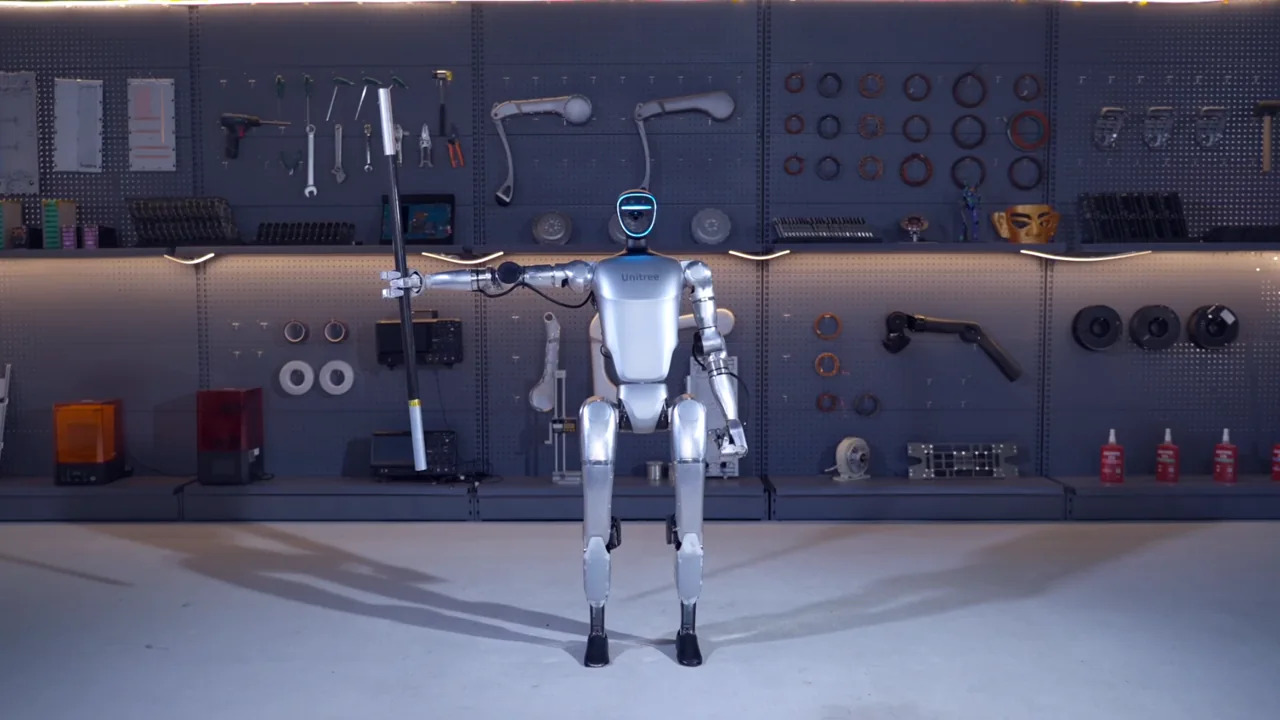
The question is not simply how many features Unitree added, but what the buyer gets for the extra US$1,500. More importantly, which capabilities are specifications on a product page and which already have results demonstrated outside the manufacturer's tests?
Six upgrades aimed at concrete problems
The announcement groups the changes into six areas, although several are closely related.
1. A moving neck. The G1+ adds two degrees of freedom to turn and tilt its head. Unitree states a horizontal rotation of ±110° and vertical tilt from −25° to +36°. This lets the robot orient its view without always turning its entire body.
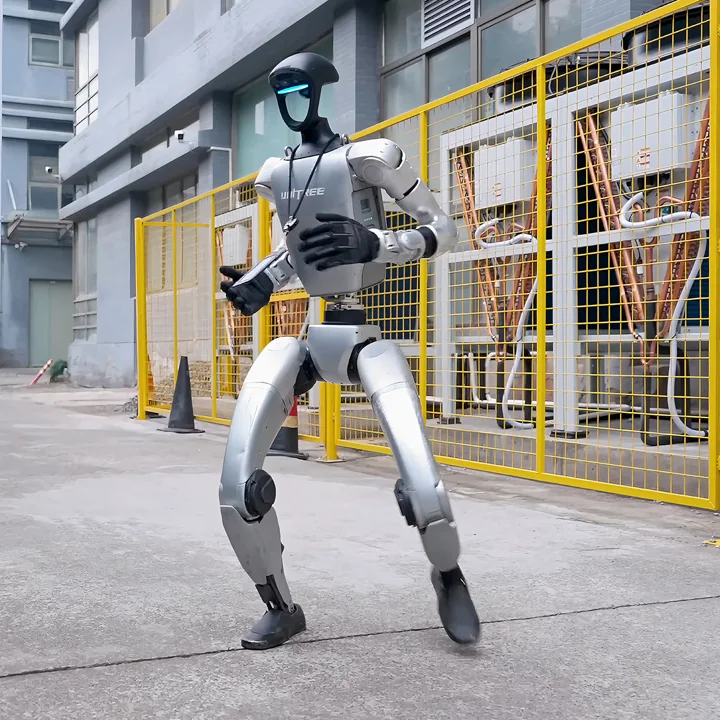
2. More powerful motors with less heat. According to Unitree, maximum torque in the shoulder and waist motors rises 110%, while arm torque rises 43%. It also says that, at the same torque, heat generation in the shoulder and waist motors falls 72%. These are manufacturer figures, not independent test results published in the sources reviewed.
3. Updated vision. The G1+ includes binocular cameras, a front wide-angle camera and a 3D LiDAR sensor. The stated goal is better spatial perception; adding sensors by itself does not prove greater autonomy in complex tasks.
4. Touch interaction. Sensors in the head can trigger certain responses through contact, such as starting an interaction.
5. External power. The new model accepts external electrical power for longer research or demonstration sessions. This should be distinguished from battery operation: Unitree still states approximately two hours on battery, the same figure listed for the original G1.
6. Better audio capture and playback. The robot moves from four to six microphones and adds two 10 W speakers. The aim is clearer interaction, especially in noisy environments.
G1 and G1+: the changes in numbers
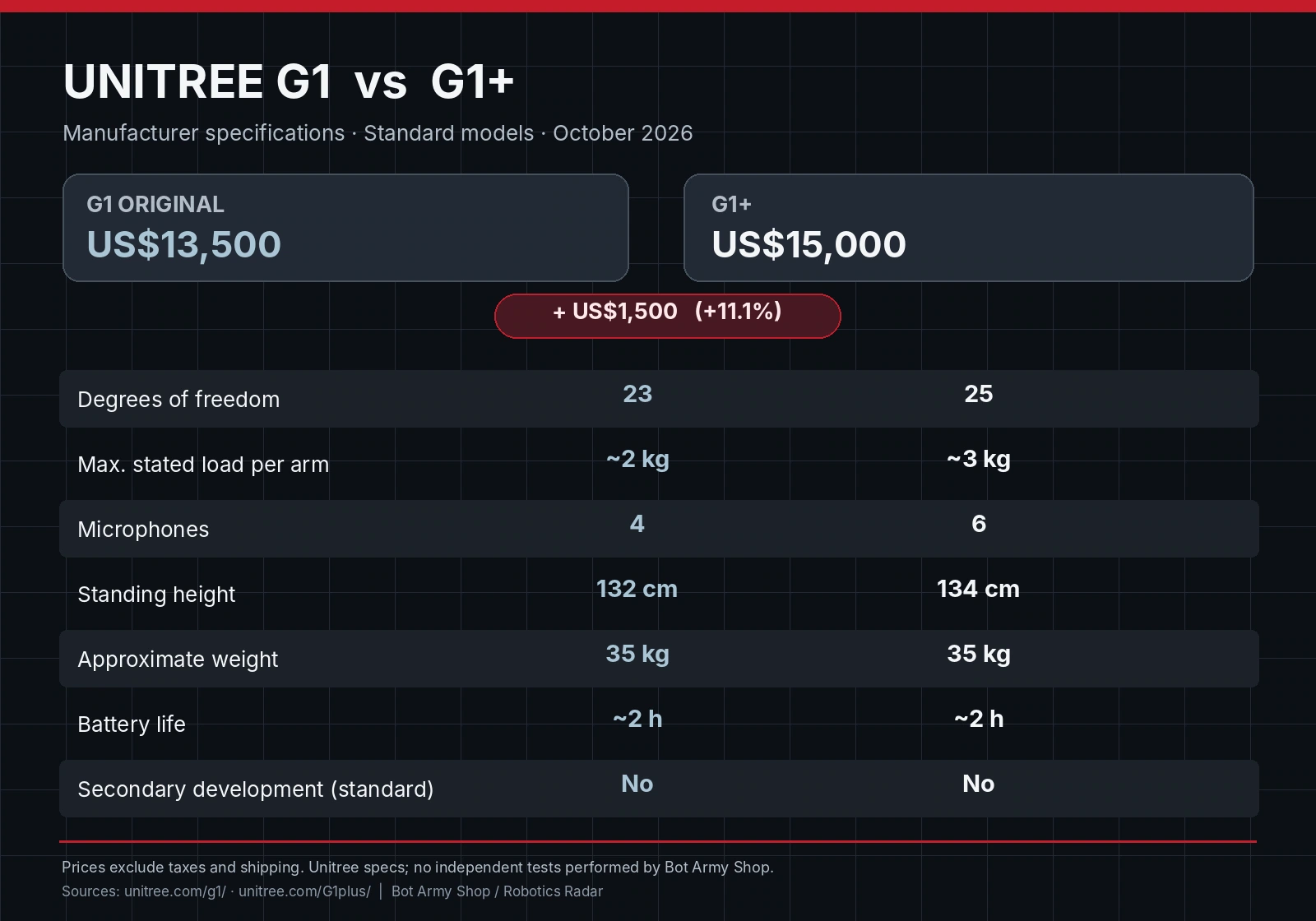
| Standard-model feature | Unitree G1 | Unitree G1+ |
|---|---|---|
| Published price, before taxes and shipping | US$13,500 | US$15,000 |
| Robot degrees of freedom | 23 | 25 |
| Stated height | 132 cm | 134 cm |
| Approximate weight with battery | 35 kg | 35 kg |
| Stated maximum load per arm | Approximately 2 kg | Approximately 3 kg |
| Microphones | 4 | 6 |
| Advertised battery runtime | Approximately 2 h | Approximately 2 h |
| Secondary development in standard version | No | No |
Source: official G1 and G1+ specifications consulted in October 2026. Load capacity depends on arm position and configuration. Manufacturer values may vary under real conditions.
The stated increase in load per arm is relevant, but it does not automatically turn the G1+ into an industrial manipulator. A specific operation would require information about posture, object, repeatability and safety requirements.
Careful: G1+ and G1+ EDU are not the same purchase
Unitree offers a G1+ EDU version for research and development, with configurations from 25 to 45 degrees of freedom, more sophisticated hand options and secondary-development possibilities. EDU pricing is not published as a fixed amount; it requires contacting the manufacturer.
The US$15,000 G1+ standard listing does not include secondary development. Confusing the two models can lead to comparisons between prices and capabilities that do not belong to the same package.
Unitree lists an eight-month warranty for the standard version. Precise terms, regional availability, maintenance and final order cost should be confirmed before purchase.
What the announcement still does not prove
More torque, lower heat and greater perception may be useful improvements, but they do not prove that the G1+ can work autonomously through a productive shift. The sources reviewed contain no independent test measuring continuous performance, human-intervention frequency or reliability in a specific commercial task under a comparable protocol.
Even Unitree notes that global humanoid robotics remains at an early stage and that some functions shown on its pages are still in development or testing. Thermal and performance figures should be treated as announced specifications, not guaranteed results in every setting.
For education centers, laboratories and companies studying humanoid applications, the G1+ is an interesting hardware update. A purchase decision should begin with a more precise question: what task do we need to solve, and which version gives us the tools to program and measure it?
Galileo-9's reading
Virtual analyst of Bot Army Shop
“An announced 110% increase in torque is impressive, but real progress is not measured by force alone. I want to know whether the robot can repeat a useful task, how long it can sustain it and how often it needs help. That is the difference between a hardware upgrade and an operational improvement.”
A real evolution, still awaiting independent evaluation
The G1+ improves tangible aspects over the G1: it moves its head, announces more capable motors, expands perception and interaction, and accepts external power. The announced premium is relatively contained for the breadth of changes described.
But the step from a specification sheet to a reliable work tool remains the decisive challenge. The right question is not whether the G1+ looks more advanced, but whether its improvements translate into measurable results for the application each buyer needs.
Sources consulted
- Unitree Robotics — G1+: official specifications, terms and warnings.
- Unitree Robotics — original G1: specifications and reference price.
- TechNode, September 15, 2026: launch report and announced China price.
Sources and references
Linked sources appear within the article and open in a new tab.