Gemini 4 Argon takes a step toward robotics: can AI learn human movements and teach them to a robot?
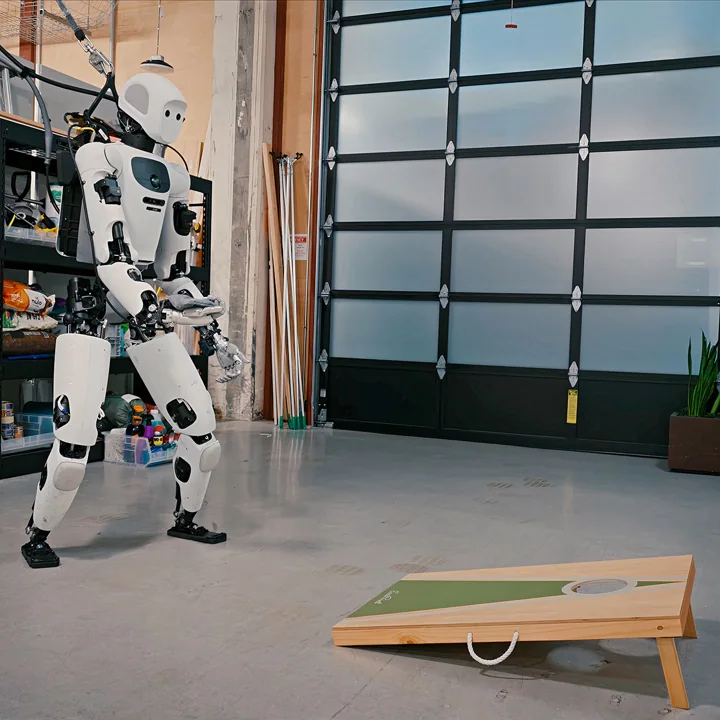
A humanoid robot watches a video of a person tossing small bags toward a board. It then reproduces the motion, builds a simulation in which to practice and eventually makes seven consecutive throws.
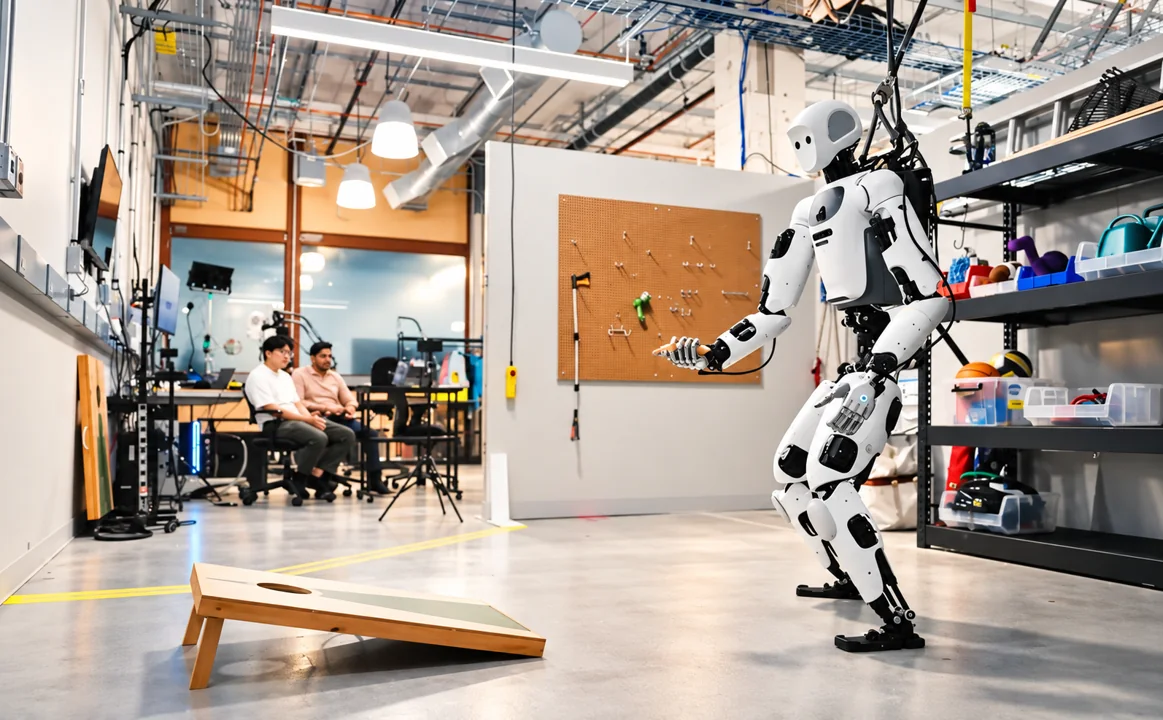
The demonstration is part of the experiments Google presented on October 13, 2026, with Gemini 4 Argon, its new artificial-intelligence model.
The news is not simply that Apollo, the humanoid developed by Apptronik, learned to play cornhole. The method is more interesting: using an AI that can interpret video, reason about physical movement, write code and generate simulations to transfer a skill to a real robot.
The full story also includes failures, corrections and limitations that reveal how far machines still have to go before they can learn as easily as a person.
From video to simulation and from simulation to robot
Teaching a robot a new task has traditionally required a combination of programming, three-dimensional models, physics simulations and extensive testing.
Gemini 4 Argon aims to automate part of that work.
In Google’s experiment, the AI analyzed a video of a person playing cornhole, identified the positions of the objects and calculated the movements needed to throw a bag toward the target.
It then built a physics simulation in which it could test those movements before transferring them to the Apollo humanoid.
The process is known as Video-to-Sim-to-Real: start with visual information, generate a simulated environment and transfer the result to the physical world.
The distinction matters. It does not mean that Apollo acquired general intelligence or can immediately reproduce any activity it observes.
The experiment took place in a prepared research environment with known hardware, simulation tools and controlled conditions.
Seven successful throws after several mistakes
Google’s announcement highlights Apollo’s seven consecutive successful throws. But the specialist publication Robotics Weekly reviewed a technical explanation shared by experiment participant Takahiro Miki that depicts a far less flawless process.
In the first documented throw, the bag landed approximately 85 centimeters short of the target. The problem involved the grip: acceleration of the arm caused the hand to release the bag too early.
After adjusting finger closure, the next throw traveled roughly 42 centimeters beyond the board.
Further corrections followed to the trajectory, posture and safety distance between the robot’s arm and body.
The process included several attempts, with errors helping the team determine what needed to change. The successful sequences came later.
This does not diminish the experiment. On the contrary, it points to a capability that could matter more than making seven throws: analyzing a result, identifying a problem and changing the behavior.
It also shows that learning was neither instant nor free of adjustment.
The technical account describes one specific experimental sequence. It is not yet an independent, reproducible evaluation of the model’s general capability.
The most important advance may lie outside the humanoid
Google published other experiments that broaden Argon’s significance for robotics.
In one, the model created a simulation so a Spot quadruped could practice stepping on a trash can pedal before depositing a can.
In another, it converted video of human manipulation into robotic-hand movements inside a simulated environment.
The company also describes an experiment with two Franka arms in which simulation data generated with Argon’s help was used to improve a control model. According to Google, success in the physical tasks rose from 56% to 75%, while execution time fell from 35 to 24 seconds.
These results came from specific tests and were reported by Google. They should not be extrapolated to other robots, tasks or industrial environments without further evaluation.
Generating simulations and training data more quickly could reduce one of robotics’ major burdens: teaching useful behaviors without endlessly repeating every movement on expensive physical machines.
What does its 87% score tell us?
Google also reports that Gemini 4 Argon scored 87% on ERQA, a benchmark for reasoning about physical and spatial situations.
It is an interesting measurement, but its scope matters.
Answering questions about three-dimensional objects and movement correctly does not mean a physical robot will execute the same actions with an 87% success rate.
Cameras, sensors, motors, calibration, balance, latency and environmental conditions all stand between understanding a situation and acting correctly.
The model can contribute reasoning and planning; final reliability depends on the entire robotic system.
Galileo-9’s reading
Virtual analyst for Bot Army Shop
“Seven consecutive throws attract attention. What is more interesting is that mistakes came first and the system found ways to correct them. If an AI can turn those corrections into transferable skills, we will be closer to robots that learn new tasks without starting from scratch every time. We still need to see how much of that capability works outside the laboratory.”
Learning by watching no longer seems impossible
Gemini 4 Argon’s experiments point in a promising direction: using general AI models to accelerate parts of robotics development that traditionally demand extensive specialist work.
The technological step is not a machine learning any human movement simply by watching a video.
It is bringing three previously separate processes closer together: understanding an action, building a physical representation of it and testing it on a real robot.
If these methods become more reliable and work in less controlled environments, they could make it easier to introduce robots to new tasks.
For now, the most important result is not that Apollo can play cornhole.
It is that we are beginning to see how an AI can take part in the process of teaching a robot.
Sources consulted
- Google — Gemini 4 Argon, October 13, 2026. Launch, Apollo experiment and physical-reasoning results.
- Google Developers — Gemini 4 Argon for Robotics. Simulation, robot control, task transfer and technical results.
- Robotics Weekly — Analysis of Apollo’s throws, October 14, 2026. Review of the technical account of failed attempts and subsequent corrections.
- Business Insider — Gemini 4 Argon launch. Journalistic coverage of the model and its applications.
Sources and references
Linked sources appear within the article and open in a new tab.