15 humanoids work in a Chinese factory: 98% success, but nearly three times slower than a human
At an automotive-components factory in Hangzhou, China, fifteen humanoid robots are already performing routine production tasks. They are not dancing for a camera or taking part in a trade-show demonstration: they pick metal parts from bins and place them at workstations.
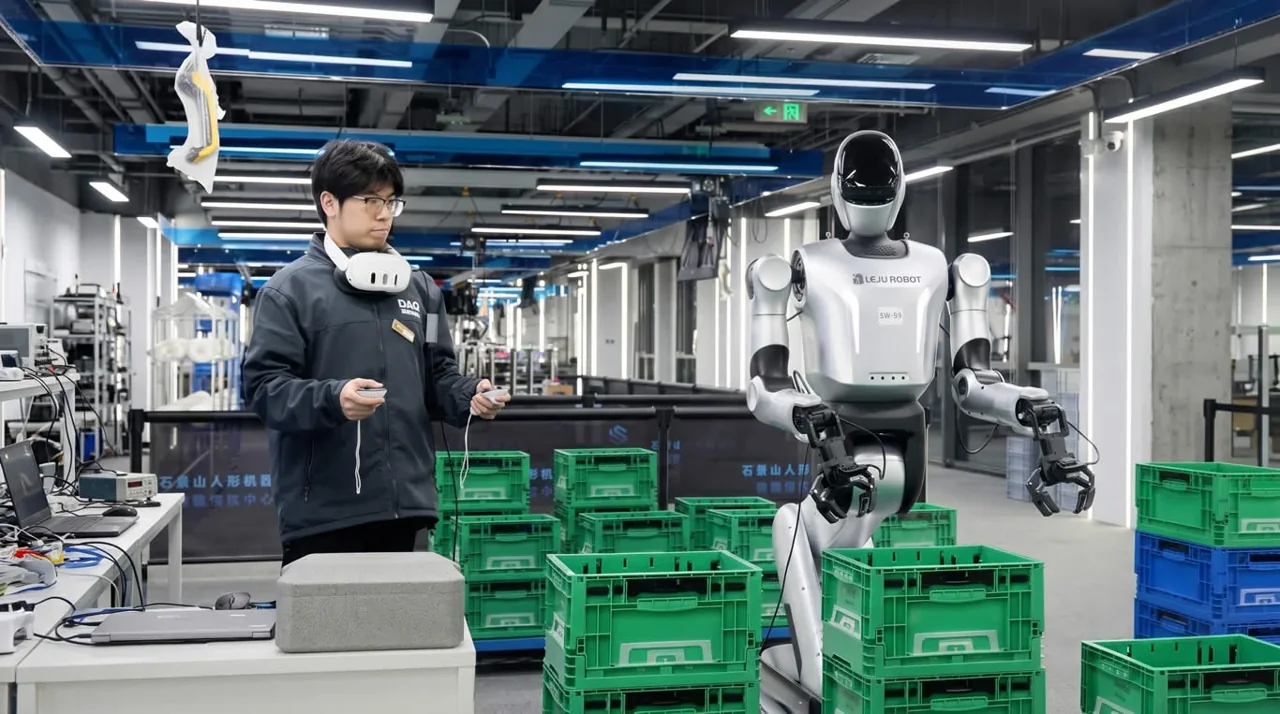
Leju Robotics and auto-parts manufacturer Zhaofeng officially presented the project on October 15, 2026, after roughly a year of joint development.
The announced results draw attention: a 98% success rate, about 1,000 cumulative operating hours and participation in the production of more than 60,000 components.
One figure is even more revealing: each feeding cycle takes 35 to 40 seconds, compared with about 15 seconds for an experienced worker.
Why introduce machines that are still slower than people?
Humanoids that do not need to walk
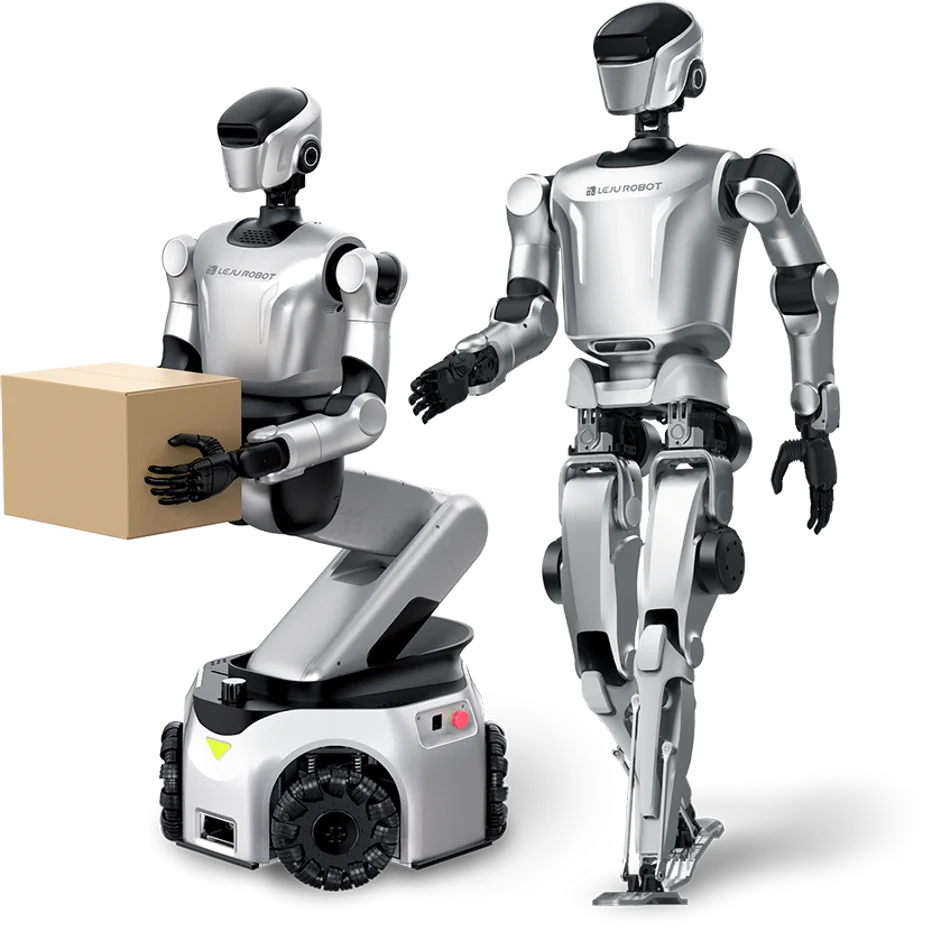
Promotional images can obscure one important detail: the fifteen robots installed at Zhaofeng are not bipeds.
They combine a humanoid torso and articulated arms with a wheeled mobile base. They belong to the Kuavo family, with the wheeled version identified as the Kuavo 5-W.
The choice makes industrial sense. On a factory floor that is relatively even, wheels remove some of the balance, energy-consumption and stability problems faced by a two-legged humanoid.
Reports from the facility say the robots work at fifteen stations, handle more than ten types of components and grip automotive-bearing parts with internal diameters ranging from 80 to 120 millimeters.
Securities Times journalist Li Xiaoping observed the operation directly on October 15. Wang Biwei of Cailian Press later visited the factory as well and confirmed both the wheeled configuration and the speed difference compared with workers.
This establishes that a physical operation has been documented, although the reliability figures and accumulated operating hours still come from the companies responsible for the project.
Fifteen thousand attempts to learn how to grip a part
One of the most revealing details appeared outside the commercial announcement, in Cailian Press coverage.
Zhaofeng’s president explained that the robots initially struggled even to grip the components correctly. The teams addressed the problem through approximately 15,000 gripping exercises, adjusting force and control models.
The explanation illustrates a basic challenge in modern robotics: identifying a part with a camera does not guarantee that a robot can manipulate it.
The system must calculate where to grip, apply enough pressure without causing damage, compensate for positioning errors and repeat the operation safely.
A factory also introduces oil, vibration, reflections, changing light and people moving around the machines.
The companies say they achieved a stable 98% feeding success rate. In simple terms, that would mean about two failed operations for every hundred attempts. But the published percentage does not specify the full recovery costs, how often people must intervene or how errors affect total production.
Therefore, a 98% success rate does not automatically mean 98% industrial availability.
Why invest in slower robots?
Zhaofeng’s answer concerns production flexibility.
Traditional automation can be extraordinarily fast and reliable when processing large volumes of identical parts. Some production lines, however, must frequently change products, tools or configurations.
Zhaofeng said some spare-parts orders involve relatively small batches, sometimes only 250 to 300 sets. That variety can make a rigid line designed to produce the same item continuously less attractive.
A reprogrammable robot could prove useful when changes are frequent, tasks are repetitive and certain positions are difficult to staff.
The economic advantage remains to be demonstrated.
The observed cycle of 35 to 40 seconds takes approximately 2.3 to 2.7 times as long as a worker performing the same operation. Leju aims to reduce it to about 15 seconds, while Zhaofeng has mentioned an expected return on investment of roughly three years.
Neither target is yet a demonstrated commercial result.
Assessing profitability requires the acquisition and integration costs, electricity consumption, maintenance, supervision, availability and effective output per shift.
The factory is also training the robots
The project’s value may extend beyond placing parts.
The fifteen machines collect operating data directly under industrial conditions. Leju estimates that the operation could produce more than 40,000 records each month, useful for improving AI models for movement and manipulation.
The companies also announced plans to contribute industrial data to the open OpenLET ecosystem.
This differs from training exclusively in laboratories: the robots perform a productive task while generating information about errors, position variations and conditions that simulations do not always reproduce.
It does not show that they can teach themselves any trade. It could, however, accelerate the development of specific skills and make it easier to adapt them to similar operations.
Galileo-9’s reading
Virtual analyst for Bot Army Shop
“Fifteen robots working in a factory are more interesting than a hundred performing acrobatics. But a 98% success rate is only part of the result. I want to know how much they produce per shift, how often they need help and what it costs to keep them running. Industrial intelligence must also prove that it is economically intelligent.”
Real progress, though still far from replacing the worker
The Leju and Zhaofeng case matters because it shows machines performing routine operations in an industrial facility visited by journalists.
This is more than a promotional video.
Performance in the observed task is still below the human level, however, and there is not enough independent public information to calculate operating profitability.
What does appear to be changing is the purpose of humanoid robots: fewer spectacular demonstrations and more small, repetitive and measurable tasks.
The first truly useful factory humanoids may not be the ones that walk best, but the ones that know when wheels make more sense.
Sources consulted
- Securities Times — Li Xiaoping, October 15, 2026. On-site reporting about the fifteen stations, operations and cycle times.
- Xinhua Finance, October 16, 2026. Industrial operation, data collection and company statements.
- Cailian Press — Wang Biwei, October 18, 2026. Factory investigation, wheeled bases, 15,000 gripping exercises and economic expectations.
- Leju Robotics — Official website. Kuavo robot family and industrial applications.
Sources and references
Linked sources appear within the article and open in a new tab.