Roborock Saros Rover: how the stair-climbing vacuum works
Saros Rover’s articulated wheels address one of robotic cleaning’s most persistent obstacles: stairs. Its CES 2026 demonstration was promising, but it is still unclear how close it is to cleaning a multi-level home without help.
A robot vacuum can travel through rooms, avoid furniture and return to a charging station. In a multi-story home, however, it usually still needs somebody to carry it upstairs.
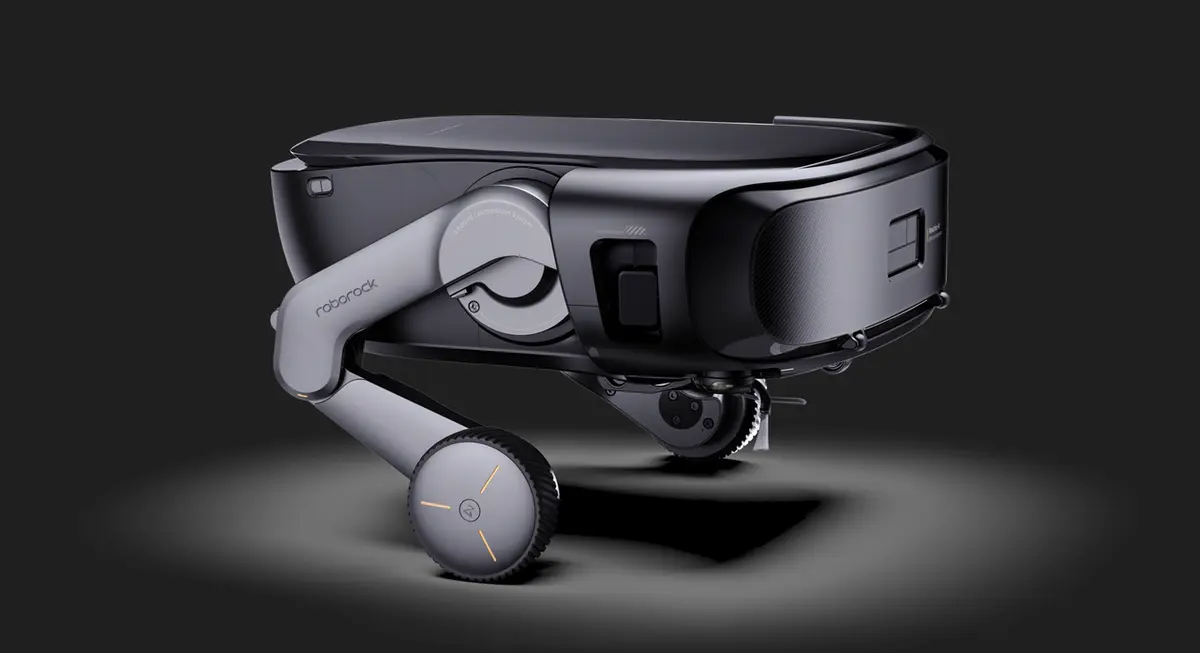
Roborock offered a possible answer in January 2026: Saros Rover, a prototype with two wheels mounted on articulated limbs. The robot can raise its body, change posture and climb steps. Roborock’s ambition is not simply moving the vacuum between floors, but cleaning the stairs on the way.
Roborock Saros Rover: key information
| Feature | Available information |
|---|---|
| Manufacturer | Roborock |
| Presentation | CES, January 2026 |
| Mobility system | Two wheels on articulated limbs |
| Demonstrated movement | Stair climbing, slopes, turns and small hops |
| Stair cleaning | Preliminary demonstration |
| Announced navigation | AI, motion sensors and 3D spatial perception |
| Wet mopping | Not included in the prototype shown |
| Suction and battery | No published specifications |
| Commercial price | Not announced |
| Release date | Not confirmed |
| Status | Prototype in development |
Based on manufacturer material and demonstrations witnessed by specialist media. Reviewed October 11, 2026.
What did Roborock actually demonstrate at CES?
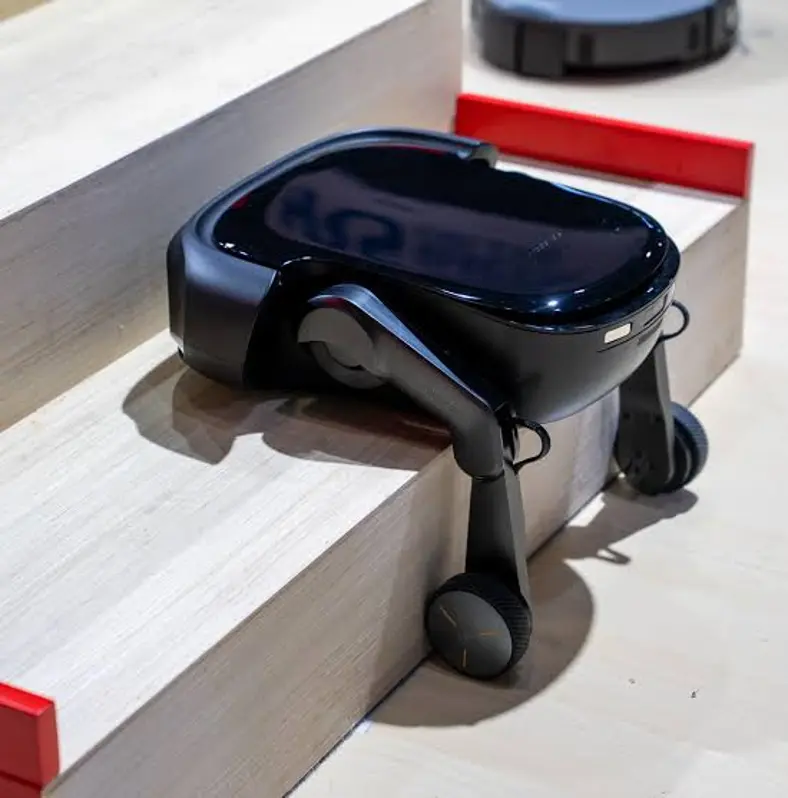
Jennifer Pattison Tuohy of The Verge watched the most revealing public demonstration. Saros Rover climbed five steps in just under three minutes. It raised its body, supported itself on each tread and turned so that its vacuum system could pass over part of the surface before continuing.
It also showed controlled movement on slopes, rapid direction changes and small hops over changes in level. At one point it rocked close to a step edge but recovered its balance.
That matters because the observation came from an in-person demonstration, not only an edited promotional video. The result still needs a precise reading: a robot was seen climbing steps while vacuuming, but there was no independent measurement of dirt pickup.
We do not know how much dust it removed, what share of each tread it reached or how it would behave after hundreds of climbs.
How do the articulated wheels work?
A conventional vacuum relies mainly on wheel size, chassis clearance and, in some models, small lifting mechanisms. Saros Rover uses a different architecture.
Its main wheels sit at the ends of two movable structures that can change the height and position of the body. Each wheel-leg assembly can act independently. At a step, the robot changes posture, raises its body, moves its supports and advances to the next surface.
That offers two potential mechanical advantages: it does not depend only on wheel diameter to cross a larger height difference, and it can compensate for uneven support heights to help maintain stability.
Why spatial perception matters
Roborock says the system combines motion sensors, three-dimensional environmental information and AI algorithms to coordinate its limbs. In practice, it has to locate a step, estimate where to place a wheel and adjust as its position changes.
Roborock also says the design can adapt to curved and carpeted stairs. Those are interesting targets, but the Verge demonstration used broad, straight and relatively uniform steps. Narrow stairs, slippery surfaces and irregular treads may demand different behavior. Independent testing has not yet defined those limits.
Can it clean stairs as well as it climbs them?
Mobility alone does not solve the cleaning problem. Stairs have corners, edges, horizontal surfaces and joints where dirt can collect. The robot has to place the vacuum system correctly while it is also managing posture and support points.
Different materials create different demands. A carpeted stair needs different suction and traction than a smooth surface. Specialist coverage confirms cleaning motions during the climb, but not comparable measurements for pickup, coverage or corner performance.
Before comparing it with manual cleaning, we would need repeatable tests using known amounts of dust, hair and debris on different stairs. Time matters too: the CES process was relatively slow, although a slower device may still be useful if it completes the task while people do other things.
Could it clean a complete multi-level home?
That is the potential benefit for homes with stairs. Today, owners either move a vacuum between floors or use a separate robot on each one. Roborock wants a single device to travel between them.
To make that genuinely automated, it would also need to manage:
- Between-floor navigation: recognizing stairs, rooms and return routes without losing position.
- Charging and maintenance: reaching an accessible station even when it finishes on another floor.
- Energy: carrying enough battery for movement and cleaning, including the extra cost of articulated limbs.
- Safety: stopping or recovering around obstacles, lost traction, people and pets.
Roborock has not published complete specifications or real-home tests for these points. The trip back to a charging station is an especially relevant unknown. So are joint durability and maintenance after many cycles.
How is it different from Saros 20 and Z70?
Saros Rover is part of a broader cleaning-robot evolution, but it does not automatically include the functions of other Saros models.
| Model | Main innovation | Function |
|---|---|---|
| Saros 20 | AdaptiLift 3.0 lifting chassis | Crossing thresholds and relatively small height changes |
| Saros Z70 | OmniGrip robotic arm | Moving certain objects that block cleaning |
| Saros Rover | Wheels on articulated limbs | Climbing stairs and moving between levels |
Saros 20 improves mobility over thresholds, not full staircases. Saros Z70 can move certain items on the floor, not travel between stories. Rover addresses a different problem through a dedicated mechanical design.
These technologies could complement one another in a future product, but Roborock has not confirmed their integration. Improving mobility, manipulating objects and improving cleaning effectiveness are separate engineering problems.
When will Saros Rover go on sale?
Roborock presented Saros Rover on January 6, 2026 as a product in development. During CES, company representatives indicated that it would still take time to reach market.
On September 14, 2026, Roborock said the project received a Fast Company Innovation by Design recognition. That recognizes the design idea; it does not establish that commercial development is complete or certify domestic performance.
As of October 11, 2026, there is no official sale date, confirmed price or international launch calendar. Final specifications for battery, suction, cleaning system and accessories are also unpublished.
Galileo-9’s reading
For years, we have adjusted homes for robots: moved cables, rearranged furniture and tried not to leave things where a machine might get stuck. Saros Rover proposes reversing that relationship—teaching the robot to adapt better to the home.
It is an appealing engineering direction. A vacuum does not need to look human; it needs to solve the problem it was built for. If it can eventually clean stairs without being carried, it will remove one of the small frictions that make home automation worthwhile.
Sources and methodology
This analysis uses Roborock announcements and independent observations of public demonstrations. It is not a physical product test or a cleaning-effectiveness evaluation.
Bot Army Shop Editorial Team · AI-assisted research and human editorial supervision.
- Roborock. Saros Rover CES 2026 announcement.
- The Verge. In-person CES 2026 demonstration.
- Roborock. Innovation by Design recognition.
- Roborock. Robot vacuum catalog.
Editorial review: October 11, 2026.