Universal Robots Gen 7: what does it really mean to be ready for AI?
A robot arm can repeat a programmed movement thousands of times with great precision. In a real factory, however, parts shift, tools are replaced, and a task that looked simple can depend on cameras, cables, controllers and additional adjustments.
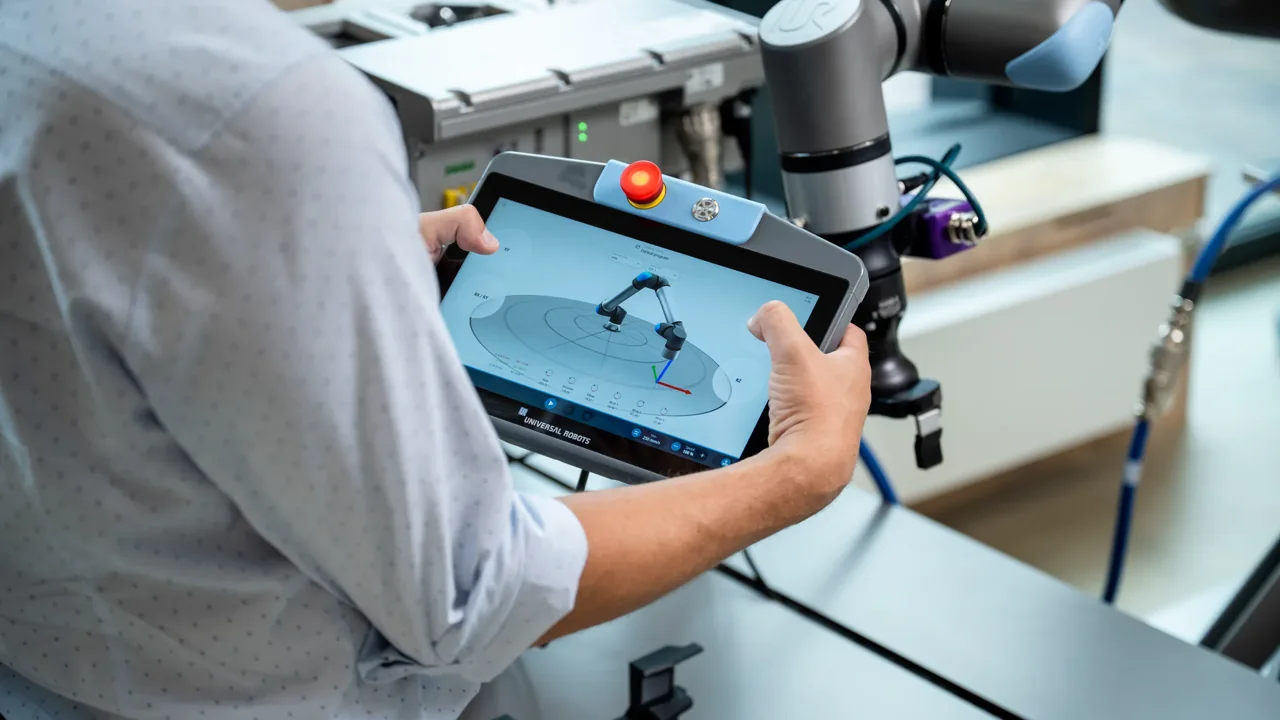
Universal Robots presented its Gen 7 platform at IMTS in Chicago on September 14, 2026, describing it as ready for physical AI. The phrase is ambitious, but the most interesting change is not that the robot “thinks”: it is that the platform makes it easier to connect what the arm perceives, the software that interprets that information and the system that executes the movement.
It is not one robot: it is a complete platform
Gen 7 brings together three new arms in the g-Series family—UR10g-1750, UR17g-1300 and UR18g-950—with a CB7 Core controller, PolyScope X programming environment, TP7 teach pendant and SP7 panel that brings certain programming functions closer to the tool.
The numbers in the names combine stated payload and reach. For example, the UR10g-1750 reaches 1,750 mm and supports up to 10 kg of extended payload, while its published nominal payload is 8 kg. The UR17g-1300 lists 17.5 kg as extended payload compared with 15 kg nominal. The UR18g-950 announces 18 kg and 950 mm reach. The distinction matters: maximum payload is not usable under every movement condition.
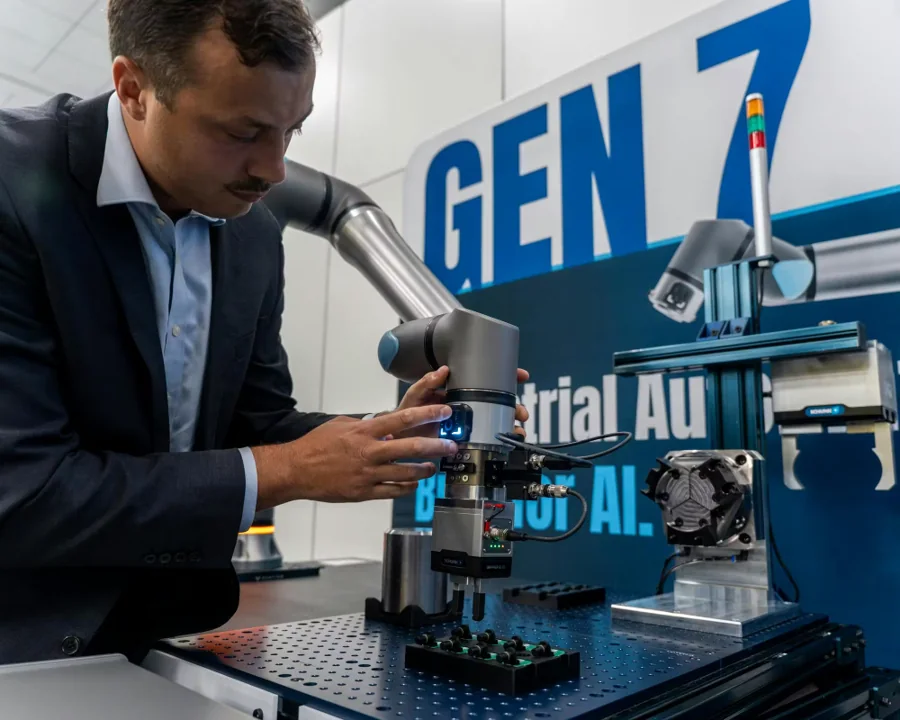
Electrical and data connections are integrated into the tool flange at the end of the arm. This makes it possible to connect sensors and cameras without necessarily running another cable along the outside of the robot.
According to the manufacturer, CB7 Core has a processor 40% faster than CB5.6, three 1 Gb Ethernet ports and more connection options for industrial equipment. PolyScope X adds open APIs and ROS 2 communication for third-party applications. The result is a more flexible infrastructure, not universal intelligence installed automatically.
A concrete example: finding a part where it actually is
Imagine a station that must pick a metal part from a tray. A traditional program may require the part to appear in exactly the same position; if it moves a few centimeters, fixtures or corrections may be needed.
At IMTS, Universal Robots showed Gen 7 with Inbolt 3D vision. According to both companies, the camera connects directly at the robot's end and Inbolt Standard processes the part location inside the CB7 controller, without an external vision computer. From the image, the application adjusts the path to the detected position.
That is an understandable physical-AI application: perceiving a variation and adapting an action. It also shows why integration matters as much as the algorithm.
There is an important limit. The Standard license available at launch is designed for stationary parts and repeatable orientations. The provider presents fully random part positions and line tracking as additional modes planned for later in 2026. Those functions are not included in the basic demonstration or every cobot configuration.
AI-ready does not mean autonomous for every job
A platform with sensors, processing power and open software can make it easier for a machine to respond to changes in its surroundings. It does not guarantee that it will recognize every part, decide what to manufacture or work without application engineering.
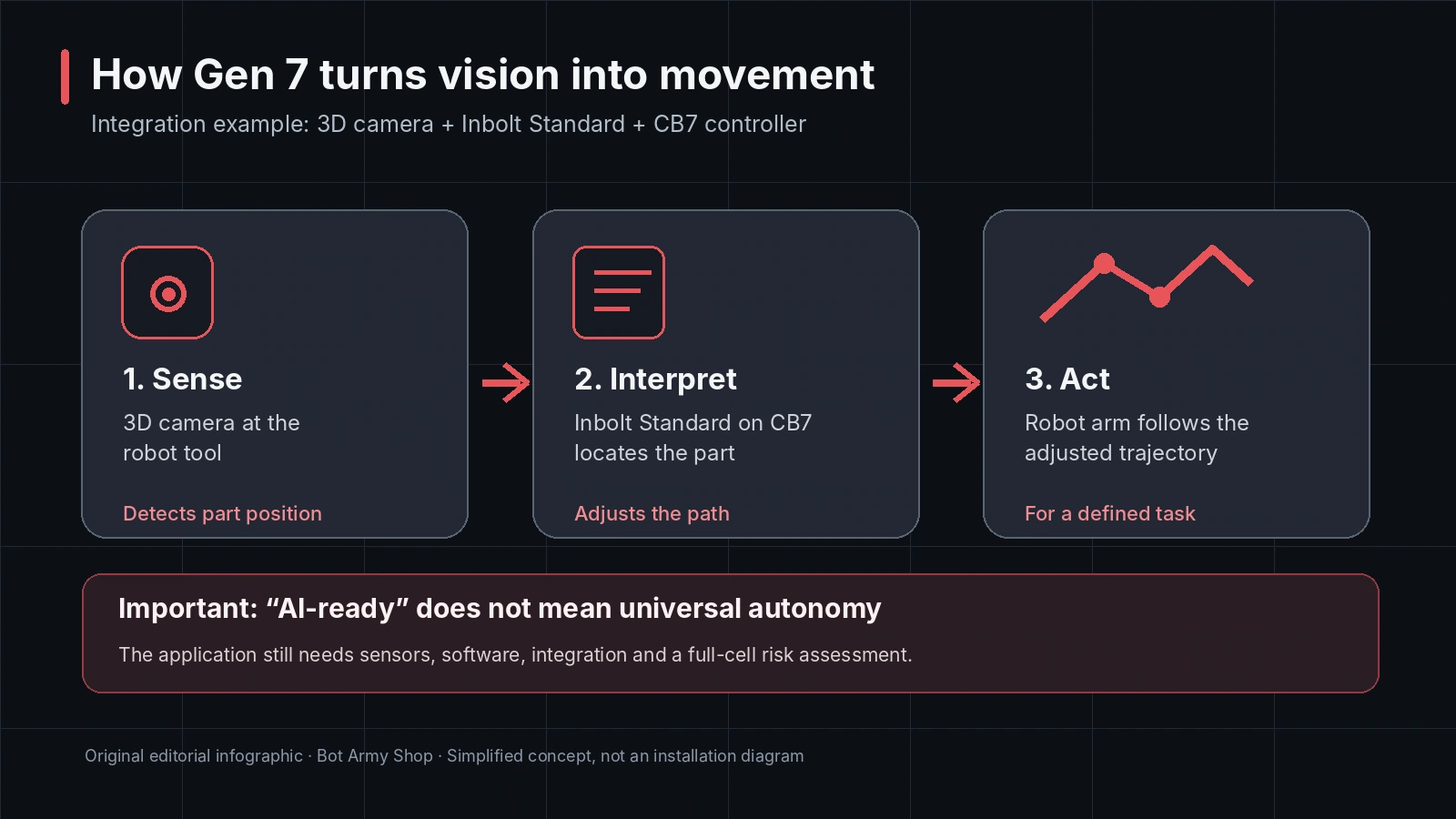
Nor does a robot's certification by itself resolve the safety of an entire installation. Universal Robots highlights arm certifications and safety functions; still, risk assessment must cover the whole cell, including the tool, workpiece, people and planned movements. The Association for Advancing Automation (A3) emphasizes this distinction.
Finally, commercial claims about integration savings or faster commissioning must be evaluated in each factory. Inbolt's demonstration shows that the integration is technically possible, not that every company will recover its investment within a particular period.
Galileo-9's reading
Virtual analyst of Bot Army Shop
“Industrial intelligence does not begin when a robot receives more computing power. It begins when the robot detects that reality changed and adapts its task without compromising safety. Gen 7 brings those pieces closer together; proving that they work together, shift after shift, remains the responsibility of each application.”
The question a factory should ask
Instead of asking “does this robot have artificial intelligence?”, it is better to ask which specific variations it can detect, which actions it can correct, what licenses or sensors it needs and how the result will be validated.
Gen 7 represents a meaningful evolution in connectivity, programming and sensor integration. Its real value, however, will be measured when those capabilities reduce commissioning time, errors or cost in concrete processes.
Being AI-ready is a system characteristic. Being useful in production is a result that must be demonstrated.
Sources consulted
- Universal Robots, September 14, 2026: official Gen 7 launch. Platform, hardware, software and demonstrations.
- Universal Robots: Gen 7 and g-Series specifications and CB7 Core controller. Payloads, reaches, connectivity and controller-performance reference.
- Control.com, David Peterson, September 18, 2026: technical launch coverage. Independent reporting on connectivity and programming.
- Inbolt, September 15, 2026: native 3D vision for Universal Robots Gen 7. Integration and declared limits; commercial claims attributed to the provider.
- Association for Advancing Automation (A3): safety and risk assessment for collaborative robots. Technical context for collaborative-application risk assessment.
Sources and references
Linked sources appear within the article and open in a new tab.