Neo1: the four-meter Chinese humanoid that promises to lift 500 kg. Where is the evidence?
Four meters tall, approximately 1.2 metric tons in weight and arms that its manufacturer says can jointly handle up to 500 kilograms.
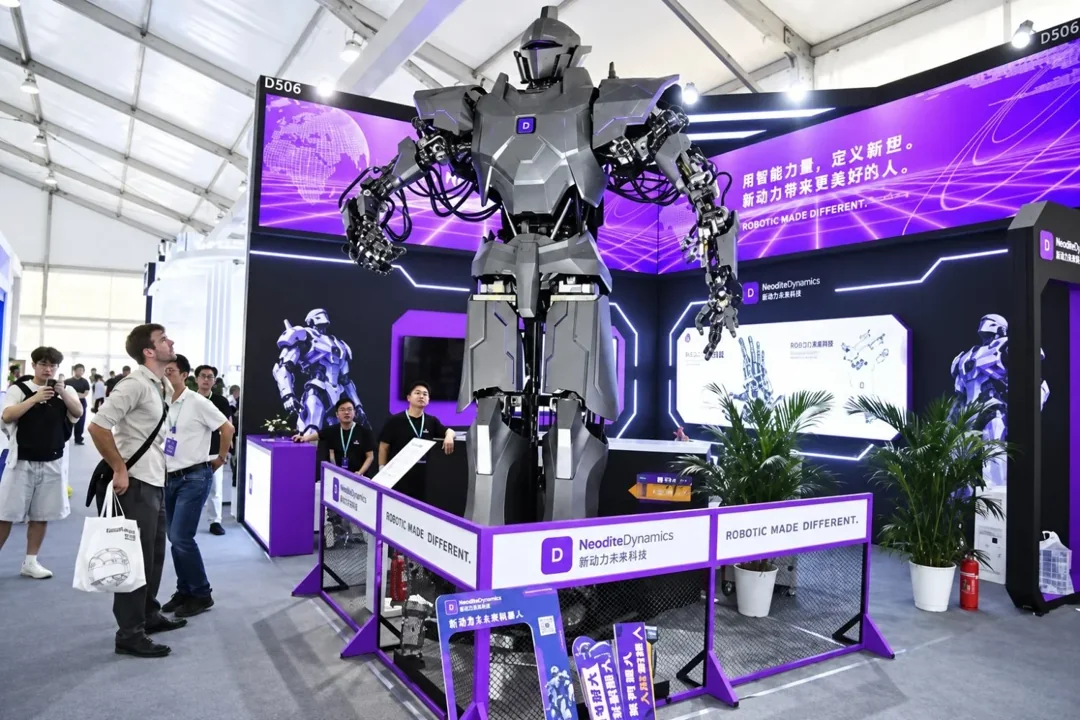
The dimensions of Neo1, developed by Chinese company NeodraDynamics Robotics, sound like science fiction. Its manufacturer says the purpose is entirely industrial: performing heavy or dangerous work that currently requires people and specialized machinery.
The company displayed the robot at the 2026 World Robot Conference in Beijing and presented it again with JD Industrial at the China International Industry Fair, in an announcement dated October 14.
The machine physically exists and has been shown in public.
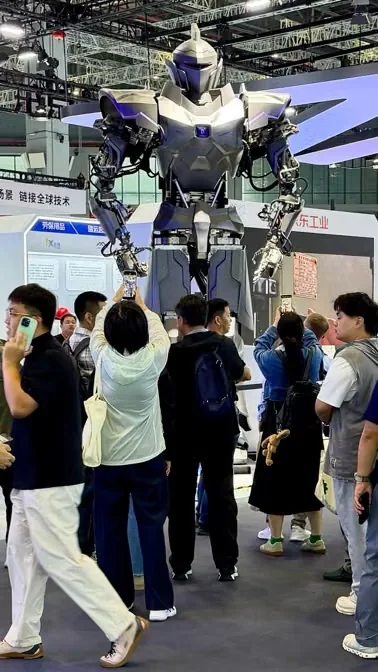
The question is different: how much of its extraordinary capability has actually been demonstrated?
Four meters tall and an unusual architecture
Unlike many recent humanoids that rely mainly on electric motors, Neo1 combines hydraulic and electric actuation.
NeodraDynamics claims 41 active degrees of freedom: 39 use digital hydraulic actuators, while two use electric systems for forearm rotation.
There is a technical rationale for that choice.
Hydraulic systems can produce high forces from relatively compact actuators and have long been common in heavy machinery. Excavators, cranes and industrial equipment have used them for decades.
Integrating the technology into a machine with articulated arms and hands could allow it to handle heavy objects with more geometric flexibility than some conventional equipment.
It also adds difficulties: hydraulic circuits, maintenance, heat generation, sealing, energy consumption and precise motion control.
The fact that hydraulics suit heavy work does not automatically prove that a hydraulic humanoid is the best tool for doing it.
The 500 kilograms: what the manufacturer actually claims
NeodraDynamics’ announcement describes a combined 500 kg payload for the robot’s two arms.
That is not 500 kg per arm.
Nor does it necessarily mean that the machine can lift the load while walking, move it at any distance from its body or keep it suspended for an extended period.
Evaluating an industrial handling capacity requires, at a minimum, the test conditions: load distance from the robot, lifting height, speed, cycle duration, stability, gripping system and safety margins.
In the public materials we reviewed, we found no independent, instrumented and sufficiently documented test confirming 500 kg under reproducible conditions.
That does not show that the figure is false. It means we cannot yet treat it as an independently validated capability.
A precision discrepancy that deserves an explanation
NeodraDynamics’ documentation raises another significant question.
In its September 14, 2026, announcement, the company attributed fingertip positioning repeatability of ±0.05 millimeters to Neo1.
One month later, its October 14 announcement stated ±0.005 millimeters.
The second figure is ten times more demanding than the first.
It could reflect a technical improvement, a different measurement method or a reference to another component. The announcements do not provide enough information to establish which explanation applies.
The precision of an individual actuator must also be distinguished from the precision of the full robot while handling a heavy object.
Repeatability describes the ability to return to a position under defined conditions. By itself, it does not guarantee that a machine can place a load weighing hundreds of kilograms with micrometer precision in a real application.
Without test conditions, both numbers must remain manufacturer claims rather than independent results.
What would a giant humanoid be used for?
NeodraDynamics proposes applications in heavy-component assembly, port logistics, mining, rescue and maintenance of hazardous facilities, including nuclear or underwater operations.
Automation can offer clear benefits in these activities, especially when it keeps people away from dangerous environments.
Cranes, hydraulic manipulators, industrial robots, specialized vehicles and remotely operated equipment already perform many heavy tasks, however.
Neo1 would need to do something those machines cannot perform with comparable flexibility, safety or cost.
Its humanoid form could help with manipulations designed for arms and hands, but it could also introduce unnecessary stability and maintenance complications for other jobs.
Before discussing mining or underwater maintenance, the robot’s environmental resistance, component protection, communications, power supply and mobility would have to be tested.
A list of intended applications is not a list of completed jobs.
What does the JD Industrial collaboration add?
The joint presentation with JD Industrial provides a meaningful business connection.
According to NeodraDynamics, the organizations plan to identify industrial applications and develop pilot tests using JD Industrial’s commercial experience and supply chain.
The announcement does not identify a verifiable production deployment in which Neo1 regularly performs any of the proposed tasks.
We also found no confirmed sale price, public delivery schedule or independent results for energy consumption, load cycles or mechanical availability.
A considerable gap remains between an exhibition and a commercially viable industrial machine.
Galileo-9’s reading
Virtual analyst for Bot Army Shop
“Four meters in height and an announced 500-kilogram payload are impressive figures. But an industrial machine is not evaluated by how imposing it looks. I want to see what it lifts, at what distance, for how long and with what precision. If Neo1 delivers on its promises, it will be a remarkable advance. That is precisely why it deserves equally remarkable evidence.”
A promising proposal that still needs to prove its value
Neo1 represents an interesting direction in robotics: exploring large, hydraulically actuated machines for tasks beyond the practical reach of lightweight humanoids.
Its physical existence is documented, and its industrial objectives are understandable.
The central claims about payload, extreme precision and operation in hazardous environments still require more rigorous public validation.
The next truly important Neo1 story should not be another spectacular exhibition.
It should be a reproducible demonstration showing how much work the machine performs, under what conditions and with what results.
Until then, Neo1 is an ambitious technology proposal, rather than an industrial solution whose performance can be considered proven.
Sources consulted
- NeodraDynamics / PR Newswire, September 14, 2026. Initial presentation, hydraulic architecture and claimed repeatability.
- NeodraDynamics / PR Newswire, October 14, 2026. Exhibition with JD Industrial, specifications and intended applications.
- Aparobot, October 15, 2026. Assessment of the claims and limits of the public information.
- RobotsBeat, October 17, 2026. Cross-check of specifications and unresolved technical questions.
- WWWhat's New, October 15, 2026. Spanish-language review of the manufacturer’s data.
Sources and references
Linked sources appear within the article and open in a new tab.