Faraday Future announces a humanoid from US$9,990: what the Master Mini really offers
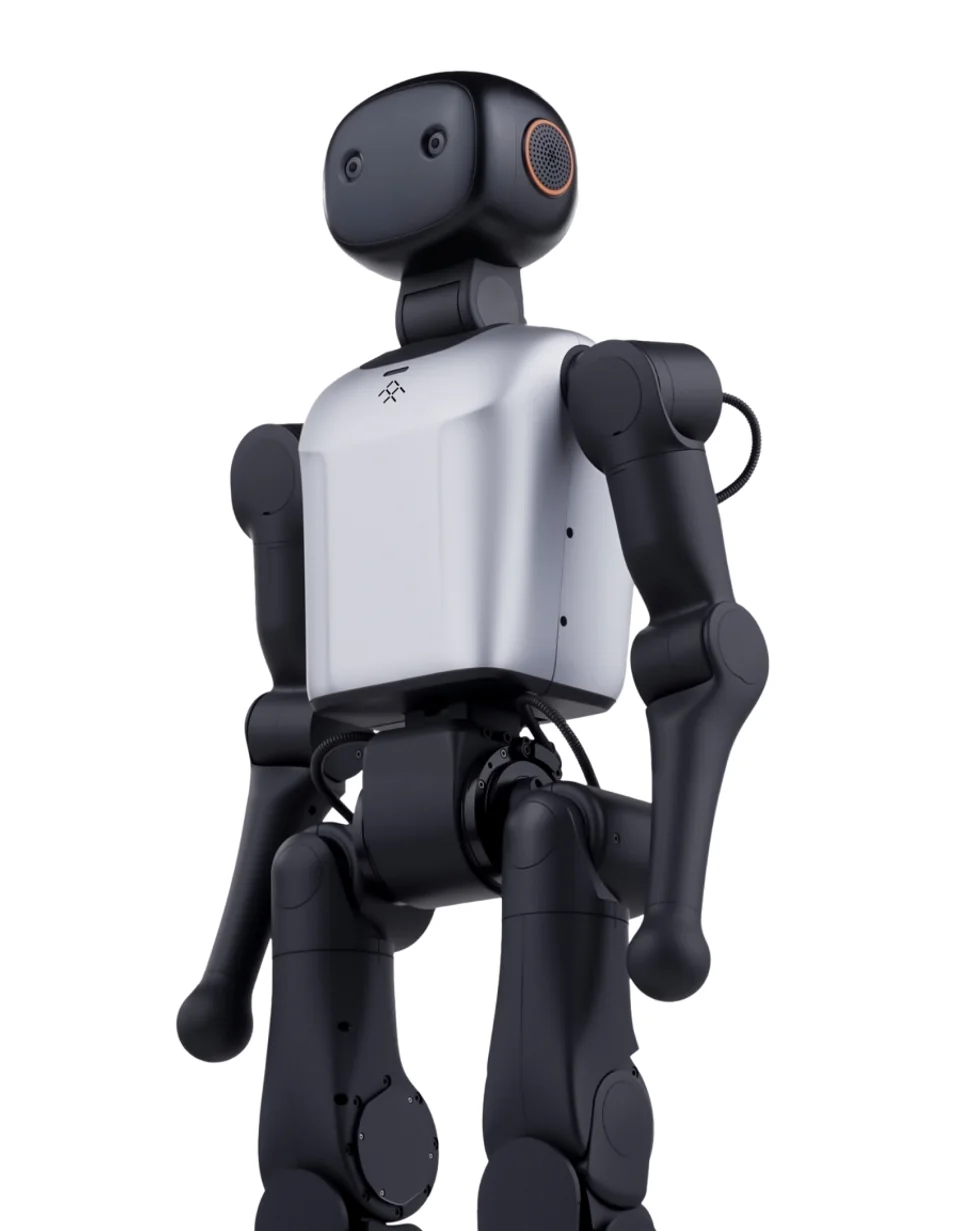
For less than US$10,000, Faraday Future says it can bring a humanoid from the lab to the classroom. The FF Master Mini is 95 centimeters tall, weighs approximately 19.5 kilograms and is intended for programming, motion-control experiments and robotic-football activities. On paper, it looks like a relatively accessible entry point to humanoid robotics.
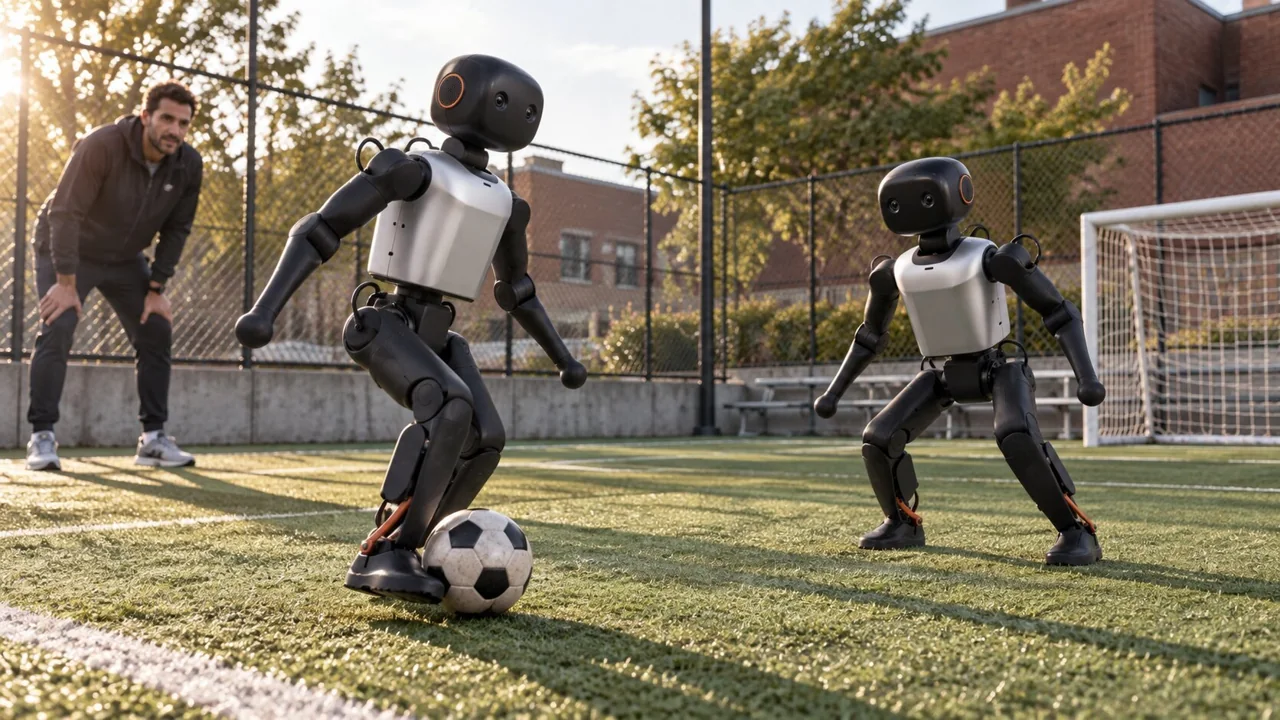
But an announcement price does not tell the whole story. What does the US$9,990 version include, which capabilities have been demonstrated and what do we know about the technology inside?
Five models, not nine completely different robots
On September 19, 2026, Faraday Future introduced nine commercial configurations spread across five new models: two humanoid families and three quadruped or wheeled-leg robots. The manufacturer said they were available for sale and delivery.
The distinction matters. These were not nine completely different designs: several options share a physical platform and change components, processing capacity or equipment. The Master Mini belongs to the compact-humanoid group, while the All-New Futurist, also announced that day, is a full-size machine starting at US$89,900.
The Master Mini is aimed mainly at education, development and robotics competitions, not at replacing workers in warehouses or factories. Independent Forbes coverage likewise describes it as an educational and research platform rather than an industrial worker ready for deployment.
The detail that changes the purchase: US$9,990 does not mean 80 minutes of autonomy
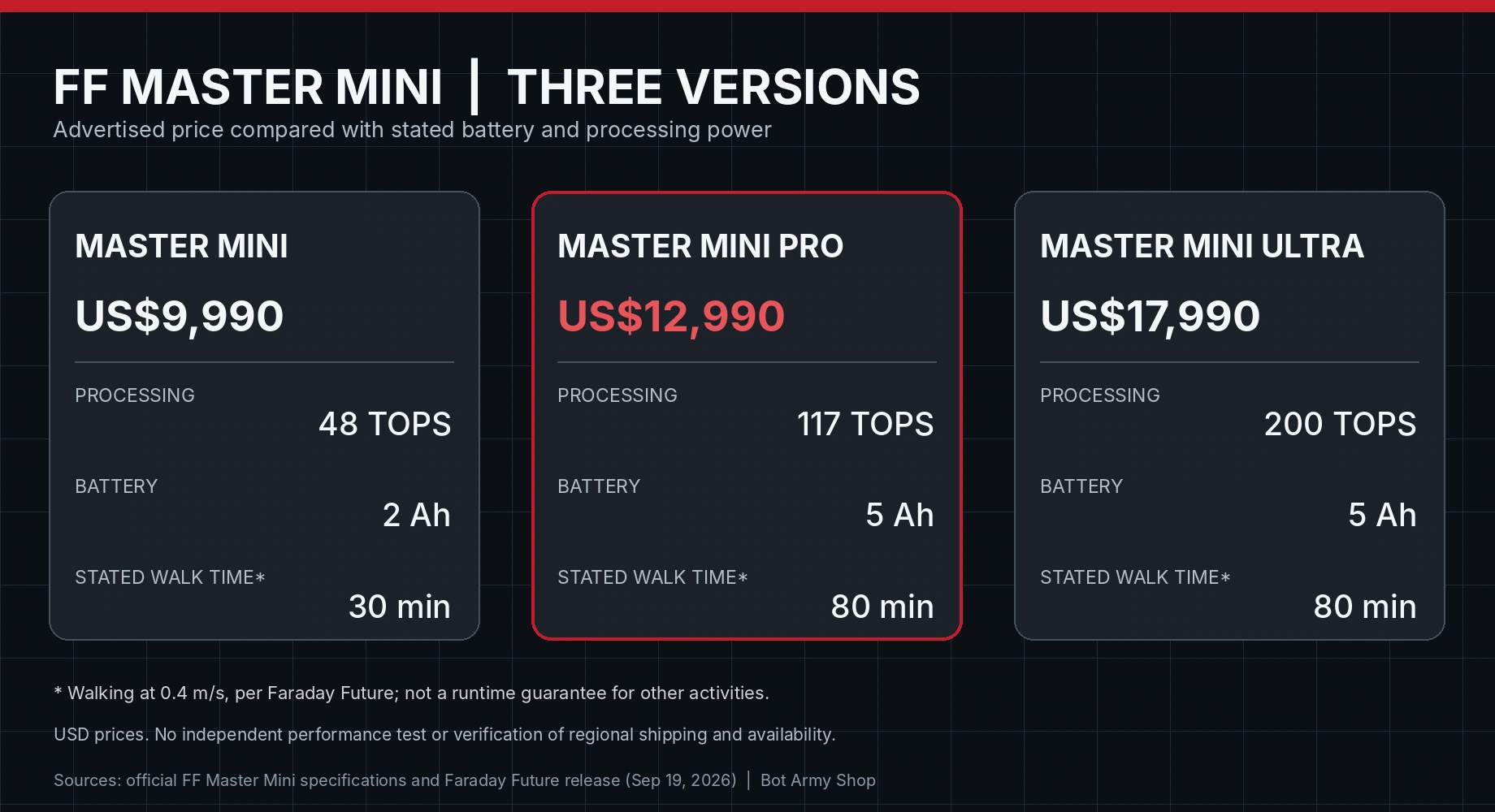
Faraday offers three versions. All share an approximate height of 95 cm, 22 degrees of freedom and similar perception sensors, but they do not have the same battery or compute power.
| Version | Announced starting price | Stated compute | Battery | Advertised walking time* |
|---|---|---|---|---|
| Master Mini | US$9,990 | 48 TOPS | 2 Ah | 30 min |
| Master Mini Pro | US$12,990 | 117 TOPS | 5 Ah | 80 min |
| Master Mini Ultra | US$17,990 | 200 TOPS | 5 Ah | 80 min |
Runtime stated by the manufacturer while walking at 0.4 m/s, not an independent measurement or promise for every activity. Dollar prices are references; taxes, shipping and country availability must be confirmed before purchase.
A student may find the entry version adequate for short programming sessions. A laboratory that needs repeated trials may care more about the announced increase from 30 to 80 minutes than about the headline price. And TOPS measures stated computing capacity, not general intelligence or guaranteed dexterity.
The commercial listing says that the US$9,990 version includes the robot, remote controller, 2 Ah battery, charger and access to development tools. It also mentions a Skill Pack valued by Faraday at US$1,000. That value is set by the company: it is not a verifiable discount and does not prove that every commercial skill is available on day one.
Is the technology proprietary? The Booster K1 clue
This raises an important question for buyers expecting original Faraday Future technology. Faraday's own store mentions a Booster controller, Booster tools and ROS 2 tools for developing Master Mini applications.
Public specifications also closely match the Booster K1: 95 cm in height, about 19.5 kg, 22 degrees of freedom, maximum joint torque of 60 N·m and 48, 117 and 200 TOPS versions. Specialist publication Humanoids Daily examined these similarities and said they point toward a K1-based platform.
This is an inference based on public documentation, not official confirmation of a manufacturing agreement or proof that both products are identical in software, service or configuration. Faraday does not detail such an arrangement in its launch release.
The company may contribute integration, support, educational services or a software layer over third-party hardware. The value of that offer will depend on what it really adds and how customers are supported after delivery.
What still needs to be demonstrated
In a Forbes interview, CEO YT Jia acknowledged a limitation in the company's broader vision for transferable robot skills: at that time, a skill trained for one warehouse could not automatically transfer to another with different conditions. He also explained that Faraday still depended on external manufacturing for hardware while planning assembly in the United States.
Those statements concern the company's overall robotics strategy, not a specific Master Mini test. They nevertheless provide useful context for expressions such as “built-in intelligence” or “skills ecosystem.”
The sources reviewed do not provide an independent, reproducible evaluation of the Master Mini that measures how many times it completes a task, at what failure rate, under what supervision or with what precision. The entry-level commercial listing announces a three-month warranty; before buying, confirm its terms, regional coverage, spare parts and technical support in writing.
For a school or developer, a useful demonstration should include SDK access, effective session time, how easily the robot can be recovered after a fall and the cost of keeping it operational—not just a video of it playing football.
Galileo-9's reading
Virtual analyst of Bot Army Shop
“A humanoid for US$9,990 gets attention. But buying the robot is only the first step: you need to know what can be programmed, how long a session lasts and who responds when a joint stops working. Real accessibility does not begin with the entry price; it begins with the ability to use and maintain the machine.”
An interesting price, with questions worth asking
Faraday Future has put a concrete offer for compact humanoids in education and development on the table. The basic model appears in its catalog and its announced specifications and price are publicly available. That is more information than a vague launch promise.
But publishing a sales page does not prove immediate availability in every market or validate the advertised performance. The possible technical relationship with Booster, the major differences between versions and the equipment warranty deserve as much attention as the US$9,990 headline.
An informed buyer does not need to distrust every announcement: they need to distinguish exactly what they are buying, who supports it and what remains unproven.
Sources consulted
Faraday Future / SEC, September 19, 2026: archived official release. Launch, number of configurations and announced prices.
Faraday Future: Master Mini specifications and official store. Versions, runtime, package contents, development tools and announced warranty.
Booster Robotics: official K1 specifications. Technical reference for the comparison.
Forbes, John Koetsier, September 21, 2026: launch interview and analysis. Commercial vision and limitations acknowledged by YT Jia.
Humanoids Daily, September 21, 2026: investigation into Master Mini and its possible platform origin. Comparison of Faraday and Booster documentation.
Sources and references
Linked sources appear within the article and open in a new tab.