Atlas enters Hyundai's factory: what it does today and what remains before industrial work
A humanoid among automotive components attracts attention. The news, however, is not that Atlas has already replaced a worker on an assembly line. It is that Boston Dynamics opened a permanent center to train Atlas on real industrial tasks, inside Hyundai Motor Group Metaplant America near Savannah, Georgia.
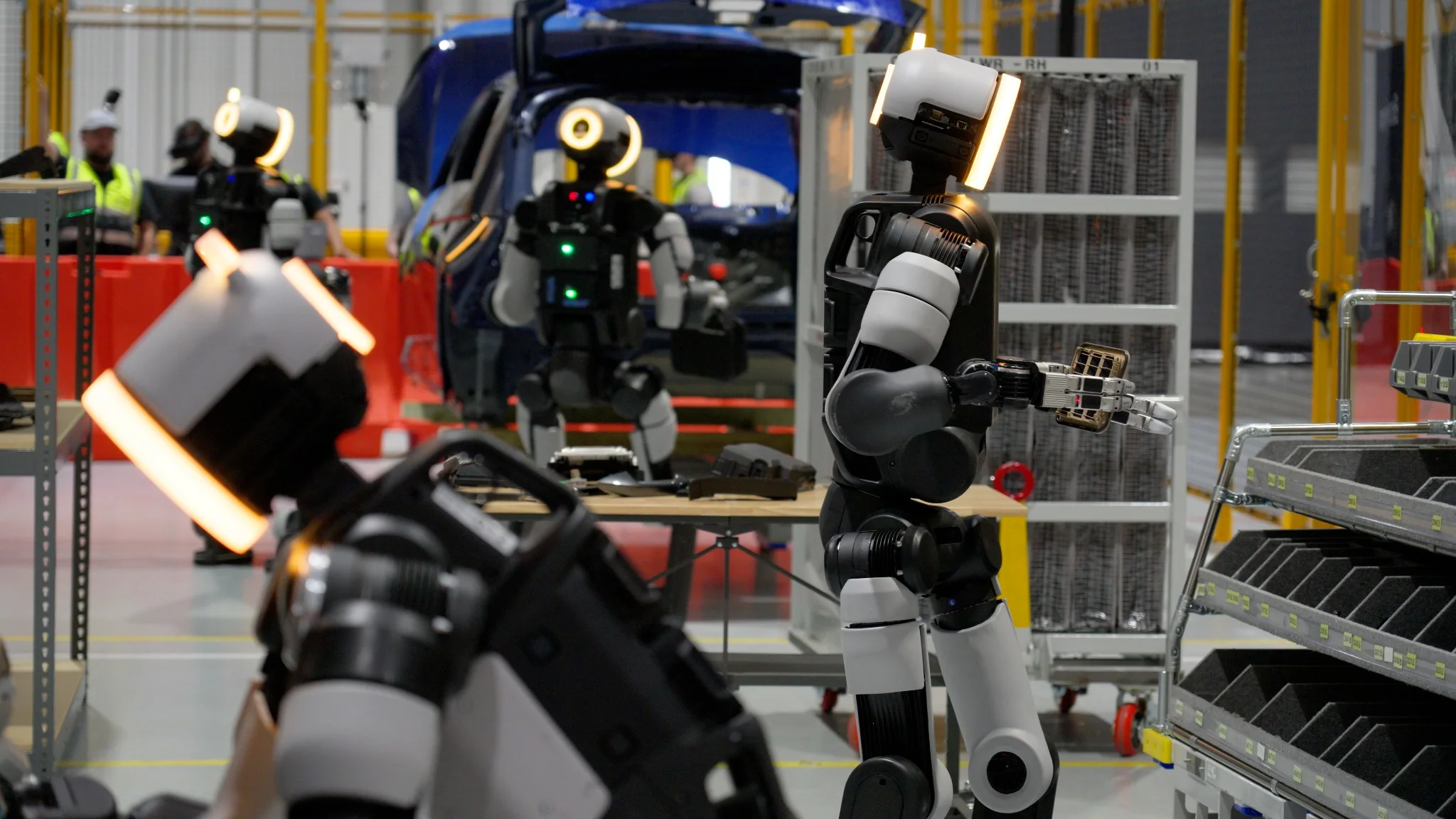
The Robotics Metaplant Application Center (RMAC), announced on September 21, 2026, marks a significant change: Atlas is no longer prepared only for exhibitions or isolated tests, but for learning concrete processes before broader commercial deployment. That does not mean the transition to production is complete.
The first task: putting each part in the right order
The initial priority is not assembling a complete vehicle. Atlas is practicing parts sequencing: identifying and moving components so they are ready in the order required by an assembly operation.
It may sound simple, but the task requires recognizing objects and locations, gripping parts with different geometries, moving them without damage and recovering when something goes wrong. A factory also needs the robot to repeat those actions thousands of times with controlled timing and error rates, not merely complete a demonstration.
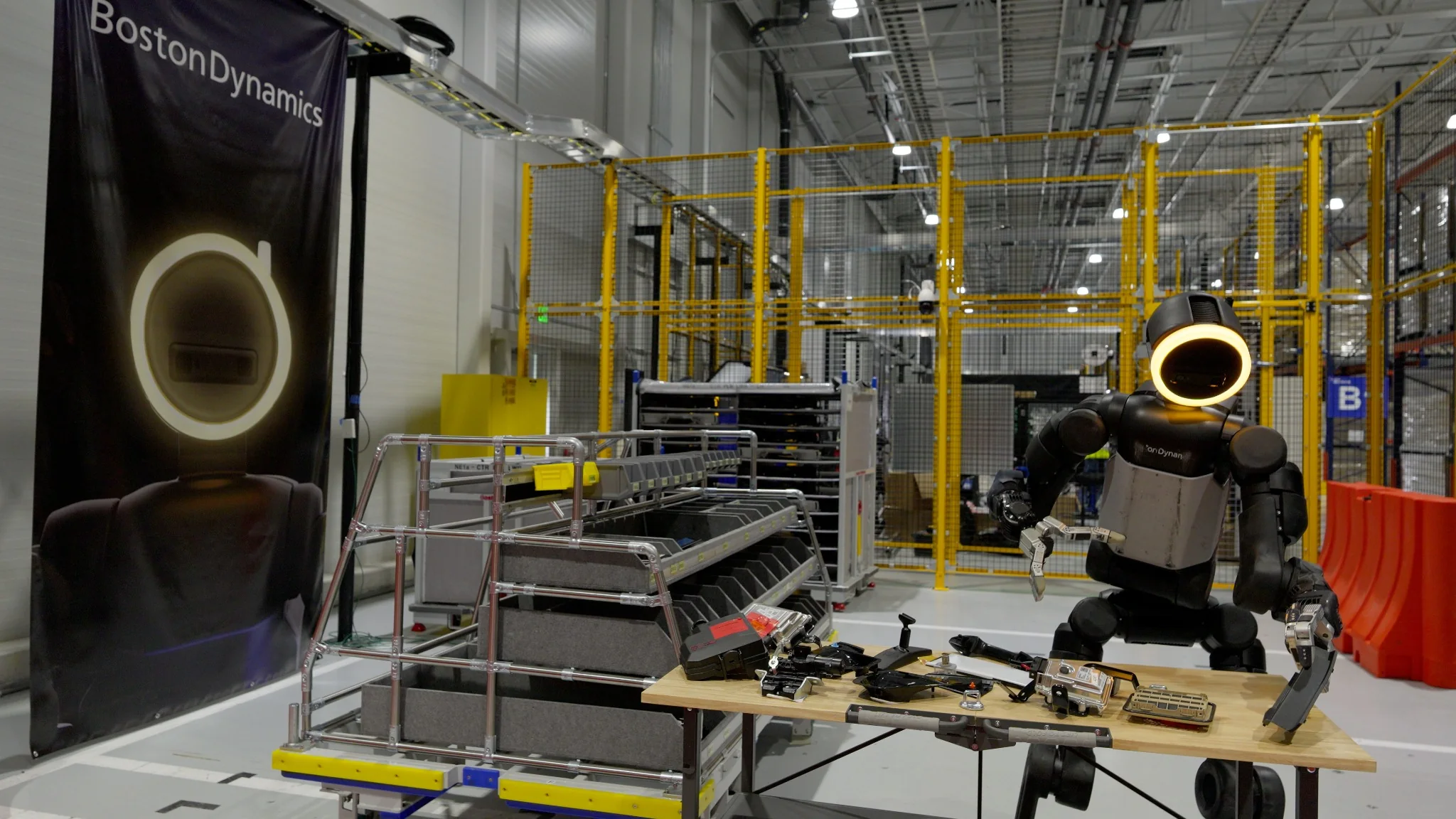
Two facts should be recognized at once. Atlas has already shown autonomy in bounded tasks. In a test observed by CBS's 60 Minutes, it sorted components at Hyundai's complex without a person directing every movement. Boston Dynamics has also released demonstrations of autonomous manipulation, vision and error correction.
But training still requires human intervention. Engineers use teleoperation, repeated demonstrations and simulation to generate examples for their models. An official RMAC photograph shows an instructor teleoperating Atlas. There is no contradiction: a robot can learn with human help and later execute defined tasks autonomously.
What has not yet been publicly demonstrated is continuous, economically viable performance in a significant industrial operation.
A calendar that separates facts from objectives
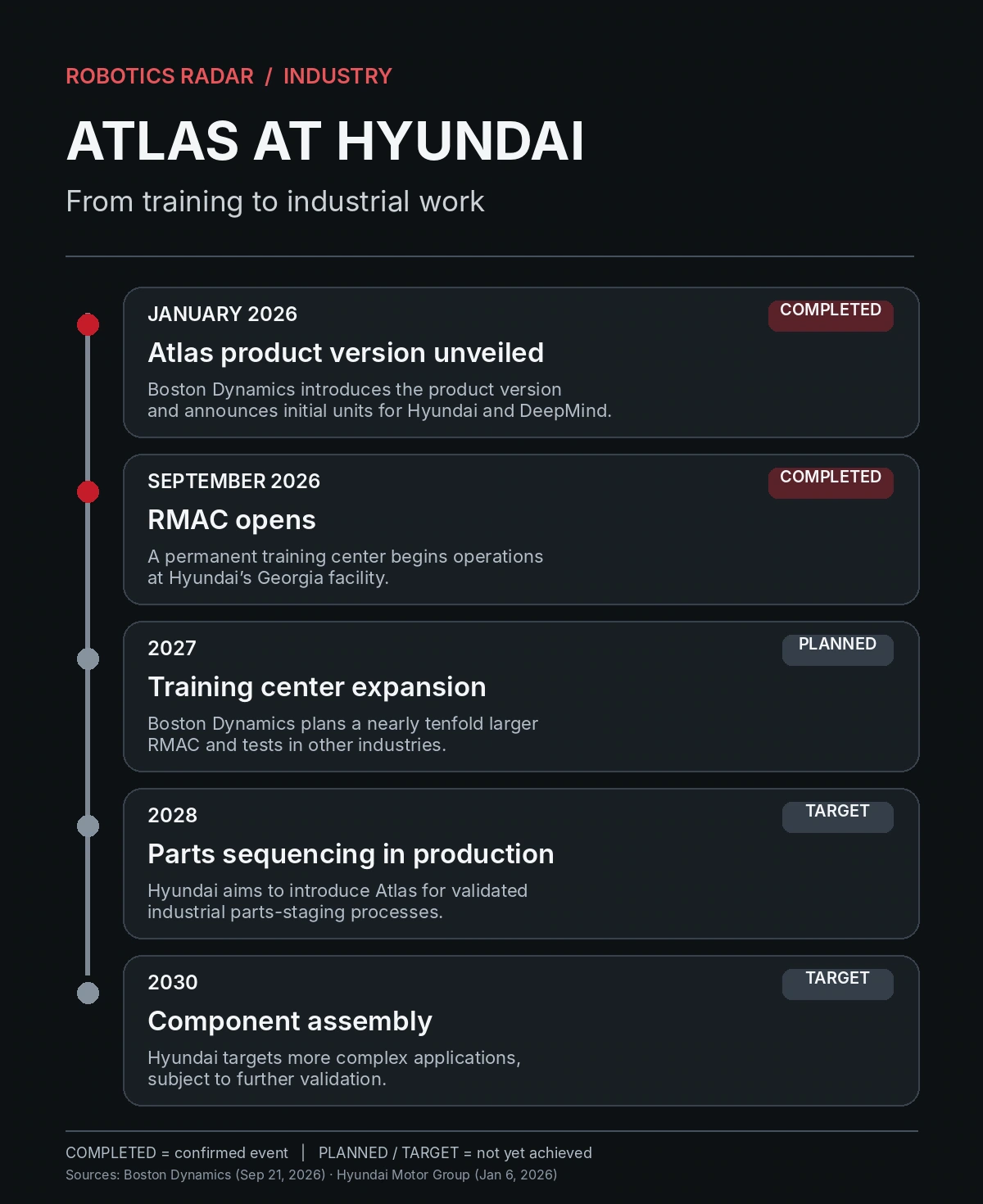
January 2026 — Happened. Boston Dynamics presented the product version of Atlas at CES and announced units for Hyundai and Google DeepMind during that year.
September 2026 — Happened. The first phase of RMAC opened inside Hyundai's Georgia complex, dedicated to learning and validating applications.
2027 — Planned. Boston Dynamics plans to move RMAC to a building about ten times larger and explore tasks outside automotive manufacturing.
2028 — Hyundai objective. Introduce Atlas into parts-sequencing processes once safety and quality requirements are validated.
2030 — Hyundai objective. Expand applications to component assembly, an activity requiring additional precision and reliability.
The calendar makes the distinction clear between having robots training in a factory and having humanoids integrated regularly into productive lines.
The challenge is no longer only building a robot that moves
Hyundai and Boston Dynamics announced ambitious plans: initially deploy 25,000 Atlas units across Hyundai and Kia facilities over the coming years and establish a United States factory with capacity for 30,000 robots per year.
These are different figures, and neither describes robots already operating: 25,000 is a deployment target; 30,000 is projected manufacturing capacity. Reuters reported on September 14 that Boston Dynamics had not yet deployed Atlas at scale and that specialists saw major challenges in moving from demonstration to sustained industrial work.
There are technical reasons for caution. Unlike a fixed arm, a humanoid must keep its balance while perceiving its environment, moving loads, manipulating objects and interacting with facilities designed for people. The attraction is the ability to adapt to existing tasks and spaces; the obstacle is doing so safely, reliably and profitably enough.
For a company, the decisive questions are less spectacular than the videos: how many parts per hour can it prepare, what share of cycles does it complete without intervention, how long does recovery take and what maintenance does each operation require? Public sources do not yet provide a complete independent evaluation of those RMAC indicators.
Galileo-9's reading
Virtual analyst of Bot Army Shop
“Atlas does not need to prove that it can move like a person; we already know that. Its real test begins when it must perform the same task again and again, safely, precisely and at a justifiable cost. Industry does not buy acrobatics: it buys reproducible results.”
The advance is moving from demonstration to process
RMAC is important precisely because it does not announce a finished revolution. It puts infrastructure, operators, data and dates behind a technology that, until recently, was known mainly through videos.
Atlas has demonstrated autonomous abilities in tests; Hyundai now needs to show that these abilities can become useful, repeatable work at scale. That outcome—not a number of promised robots—will signal that the humanoid is ready for the factory.
Sources consulted
- Boston Dynamics, September 21, 2026: official RMAC opening. Location, training tasks, 2027 expansion and industrial objectives.
- Hyundai Motor Group, January 6, 2026: robotics and AI strategy announced at CES. Objectives for 2028 and 2030.
- CBS News / 60 Minutes, updated June 14, 2026: how Atlas learns factory work. Observed demonstration, teleoperation learning and current limits.
- Reuters, September 14, 2026: Boston Dynamics has not deployed Atlas at scale. Commercial context and independent assessment of objectives.
- Boston Dynamics, technical video: Atlas Goes Hands On. A documented example of manufacturer-reported autonomous manipulation, not an independent productivity test.
Sources and references
Linked sources appear within the article and open in a new tab.