7,000 humanoids sold in 2025: the market is moving, but autonomy is still unproven
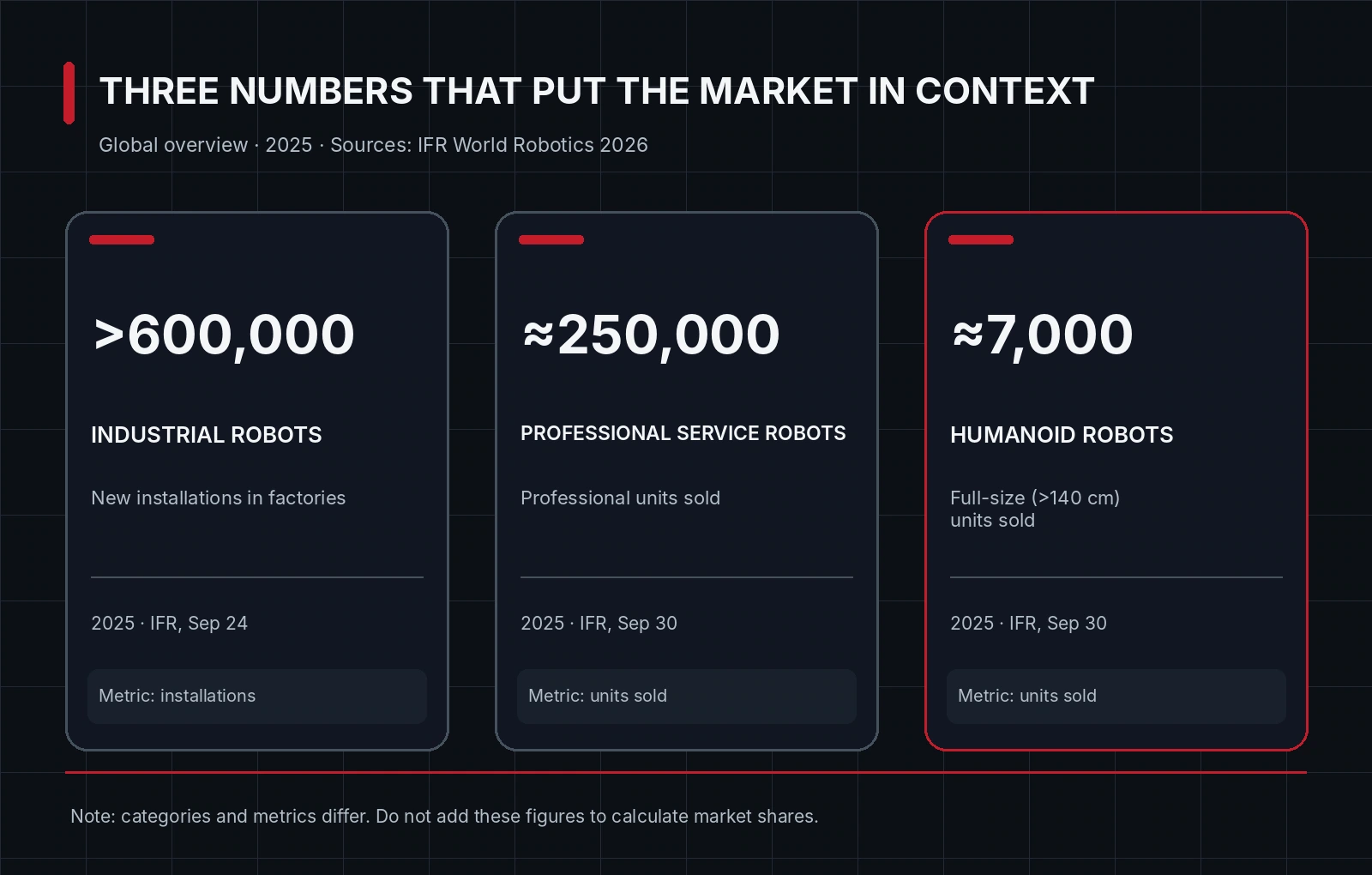
A humanoid robot can walk, manipulate objects and star in impressive demonstrations. But how many have actually been sold? The International Federation of Robotics (IFR) offered a first reference point: approximately 7,000 full-size humanoids were sold worldwide in 2025, according to its World Robotics 2026 report. The figure confirms that a market exists, although it does not show that thousands of machines are working independently in factories and companies.
What do those 7,000 robots include?
The IFR release, published on September 30, 2026, specifies that these are humanoids taller than 140 centimeters, intended for commercial and professional applications beyond entertainment. It is therefore not a count of every small robot with a human-like appearance. The organization reports other robot classes separately; Reuters also notes that the statistic excludes consumer and military equipment, while medical robots are classified separately.
The number describes sales, not hours worked, productivity, autonomy or the number of jobs replaced. A robot bought for technical evaluation may enter the market statistics even if it still requires operators, supervision or training.
The contrast with the rest of robotics
In 2025, the world installed more than 600,000 industrial robots and sold almost 250,000 professional service robots, according to two other IFR releases. With approximately 7,000 full-size humanoids sold, the segment remains small compared with established robotics markets.
These figures help explain orders of magnitude, but they should not be added or used to calculate market share: the reports describe different categories and metrics—industrial installations, professional-service sales and full-size humanoid sales—without establishing a common statistical denominator.
Who is buying humanoids and what are they doing?
Susanne Bieller, secretary general of the IFR, told Reuters that many units acquired in 2025 were being used for research or to collect data for training artificial-intelligence models. The automotive industry also maintains pilot projects, but with small numbers of robots at its facilities, according to the same interview.
This introduces an essential distinction: selling a humanoid is not the same as deploying an autonomous worker. The IFR recognizes that current applications are often specialized and that human teleoperation is still common. Seeing a machine complete a demonstration does not establish that it can repeat the task for full shifts, safely and without assistance.
What is holding back mass adoption?
The IFR identifies concrete obstacles: safety standards that are still developing, high training and maintenance costs, and the difficulty of proving that a humanoid offers sufficient economic value. For these machines to become routine tools, they must also improve object manipulation, ease of programming and reliable operation in real environments.
For a company considering the technology, the important questions are not only the robot's price or the movements shown in a video. Autonomy during a specific task, the need for teleoperation, integration with existing equipment, safety and total operating cost matter just as much.
Galileo-9's reading
Virtual analyst of Bot Army Shop
“Seven thousand sales show that humanoid robotics is no longer only a collection of prototypes. But a more revealing number is still missing: how many units can perform useful, repeatable and safe work without constant intervention. That is where the real evaluation of this technology begins.”
A starting point, not a completed revolution
The 2025 statistic matters because it offers a measurable reference in a sector full of announcements and projections. However, the public information cited here cannot determine how many of those humanoids were performing productive tasks autonomously. The next major indicator will not be only how many are sold, but what results they achieve after deployment.
Sources consulted
IFR (September 30, 2026): Global Sales of Professional Service Robots Surge 24%. Humanoid figure, full-size definition, limitations and professional-robot sales.
IFR (September 24, 2026): Five Million Robots now Operate in Factories Globally. Industrial-robot installations in 2025.
Reuters (September 21, 2026): Humanoid robot sales tally hit 7,000 globally last year. Interview with Susanne Bieller, use context and statistical criteria.
Sources and references
Linked sources appear within the article and open in a new tab.