XPENG IRON in 2026: specifications, manufacturing and launch
XPENG has brought a manufacturing line online for its IRON humanoid. That moves the project closer to its planned 2027 commercialization, but the latest material also changes several specifications announced in 2025.
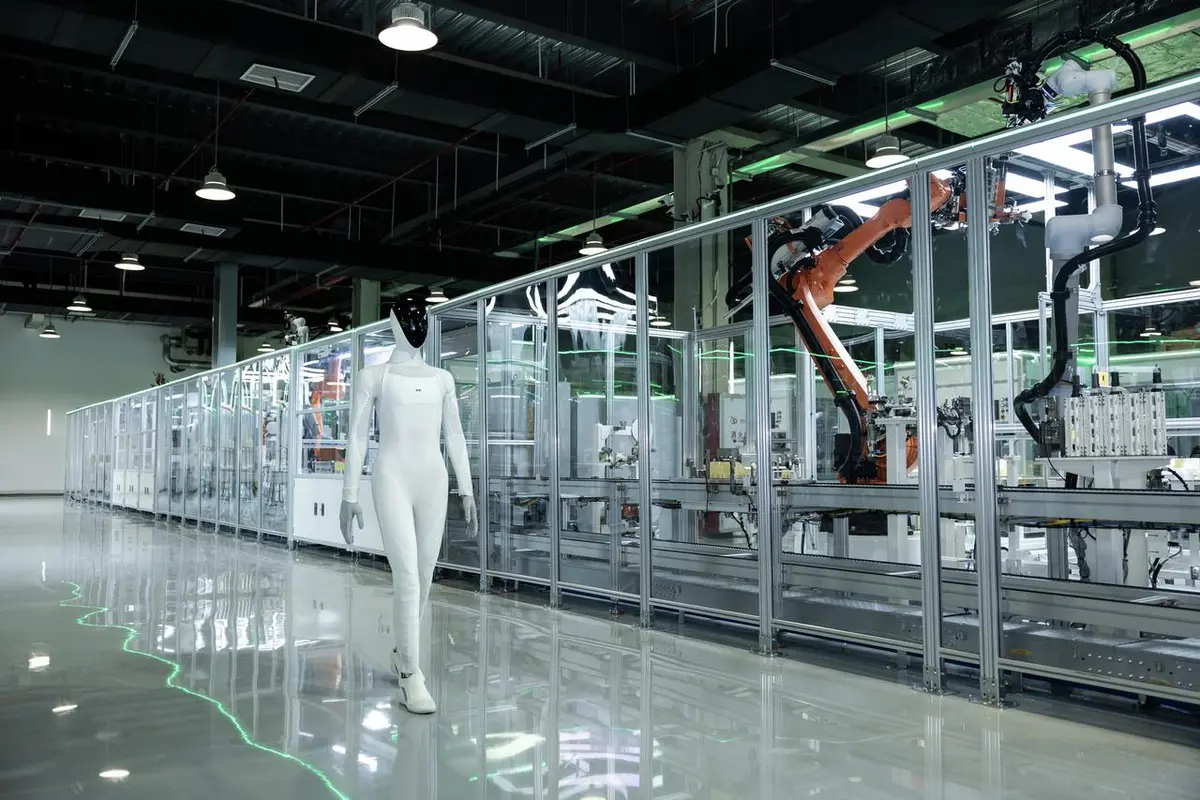
On September 8, 2026, XPENG said an IRON robot had completed assembly on a new manufacturing line in Guangzhou, China, and walked out of the facility under its own power.
It is a meaningful step for the electric-vehicle maker, which wants to apply its industrial experience to humanoid production. It is also worth comparing the original November 2025 presentation with the information published in 2026.
What changed in IRON? What does its AI system amount to? And what still has to be demonstrated before it can become a commercial product?
XPENG IRON: key specifications
| Feature | Information published in 2026 |
|---|---|
| Manufacturer | XPENG Robotics, China |
| Type | Bipedal humanoid robot |
| Degrees of freedom | 76 |
| Degrees of freedom per hand | 21 |
| Processing | Three Turing AI chips |
| Announced compute | Up to 2,250 TOPS |
| Structure | Flexible biomimetic outer covering |
| Planned initial uses | Stores, company facilities and services |
| Manufacturing line | Operating since September 2026 |
| Scale production | Target: late 2026 |
| Commercial launch | Planned for 2027 |
| Official price | Not announced |
Specifications reflect XPENG’s latest documentation. Commercial dates are company targets, not completed deliveries.
What changed between the 2025 and 2026 IRON?
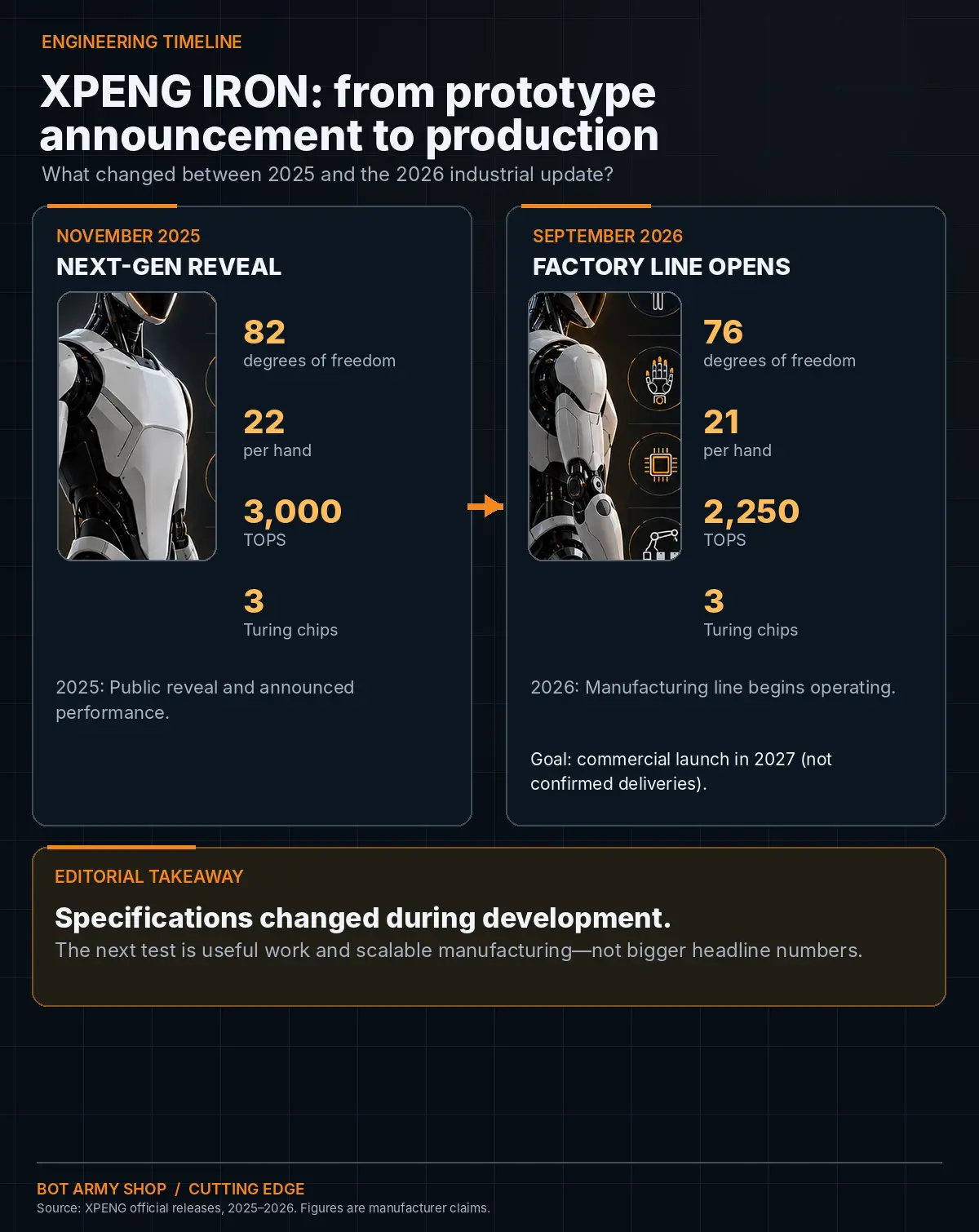
At XPENG AI Day on November 5, 2025, the company presented a new IRON generation with human-like movement, articulated hands and an in-house AI architecture. Its August and September 2026 material lists different figures.
| Specification | November 2025 | August–September 2026 |
|---|---|---|
| Total degrees of freedom | 82 | 76 |
| Degrees of freedom per hand | 22 | 21 |
| Turing AI chips | 3 | 3 |
| Announced compute | 3,000 TOPS | 2,250 TOPS |
Degrees of freedom describe independently controllable movements. In a humanoid, they affect how it can pose, move joints and manipulate objects.
The more recent material lists six fewer degrees of freedom overall, one fewer per hand, and a 25% lower announced compute figure. That does not necessarily mean IRON lost capability. Product development can change components to improve cost, energy use, reliability or mechanical complexity; the reference configuration can change as well.
XPENG has not published a detailed technical explanation for those differences. TOPS also measure operations per second under specific conditions. They do not say directly how many tasks a robot can complete or how well it makes decisions.
What does leaving a manufacturing line actually mean?
XPENG says its Guangzhou facility automates more than 80% of its main processes. It can draw on automotive experience in quality control, precision assembly and supplier coordination.
That may be an advantage over teams still building humanoids mostly as laboratory projects. But the announced 80% describes factory automation, not IRON’s autonomy. Nor does it mean the facility is already producing thousands of units.
Starting the line demonstrates industrial infrastructure. Assessing production capacity will require numbers for completed units, consistency, failure rates and manufacturing cost. A company has to reproduce a working machine reliably and at a sustainable cost, not merely make a strong prototype once.
What can XPENG IRON actually do?
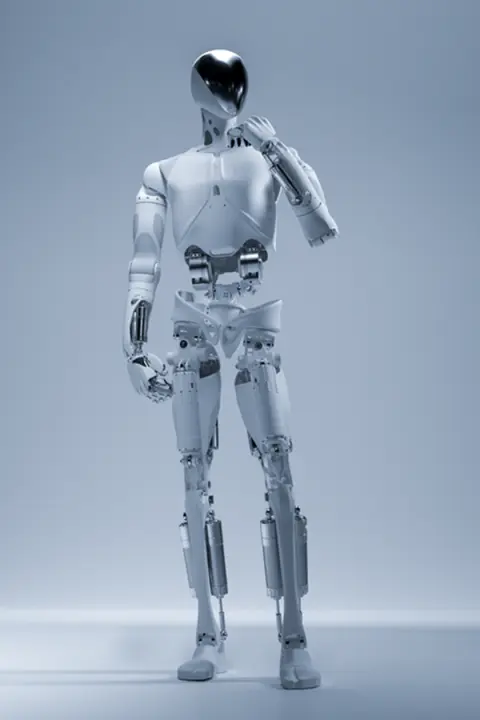
The public material shows IRON walking, making natural-looking arm movements and using articulated hands. XPENG says it intends to begin with work in stores, its own facilities and service settings.
Those demonstrations are useful evidence of mobility and coordinated motion, but they do not yet establish broad autonomy in unfamiliar workplaces. Public material does not provide comparable task-completion rates, operating hours, intervention rates or safety performance.
The important distinction is between a prepared demonstration and a repeatable task. Sorting components, for example, requires perception, selecting a grip, picking an item and recovering when something is out of place. A system can recognize a scene and still fail at a physical action.
Battery, price and availability
XPENG has not released final public figures for battery capacity, runtime, commercial price or an international delivery schedule. These are important unknowns because battery size, operating time and charging strategy will shape the work the robot can realistically perform.
The company’s stated plan is to expand production toward the end of 2026, test initial units in its own locations and begin external deliveries in 2027. Those are announced goals rather than confirmed commercial operation.
Where does IRON fit among current humanoids?
IRON belongs to a growing group of humanoids aimed at physical work, but it is not directly comparable with every product in that group. A compact research platform, a home-oriented robot and an industrially deployed system may all walk on two legs while serving very different purposes.
XPENG’s differentiator is its attempt to connect humanoid development with an existing manufacturing organization. The next useful evidence will come from clearly described tasks in stores and company facilities, not from appearance or a processor number alone.
Galileo-9’s reading
A factory line is not the finish line. It is the point at which a robot must stop being an impressive individual and become a machine that can be built, maintained and trusted more than once.
IRON makes XPENG’s industrial ambition tangible. The proof that matters next is simpler: how many units can do which tasks, for how long, and with what human support?
Sources and methodology
This analysis is based on XPENG’s public material and reporting about its announced manufacturing progress. It is not a physical product test or an independent performance evaluation.
Bot Army Shop Editorial Team · AI-assisted research and human editorial supervision.
- XPENG. Official IRON material and company announcements.
- XPENG. IRON manufacturing and launch information.
Editorial review: October 11, 2026.