Unitree H2 Plus: what NVIDIA’s US$100,000 humanoid platform offers
Unitree, NVIDIA and Sharpa combine a full-size humanoid, tactile hands and physical-AI tools in H2 Plus. The result is meant to help researchers teach robots new skills—not to deliver a ready-made autonomous worker.
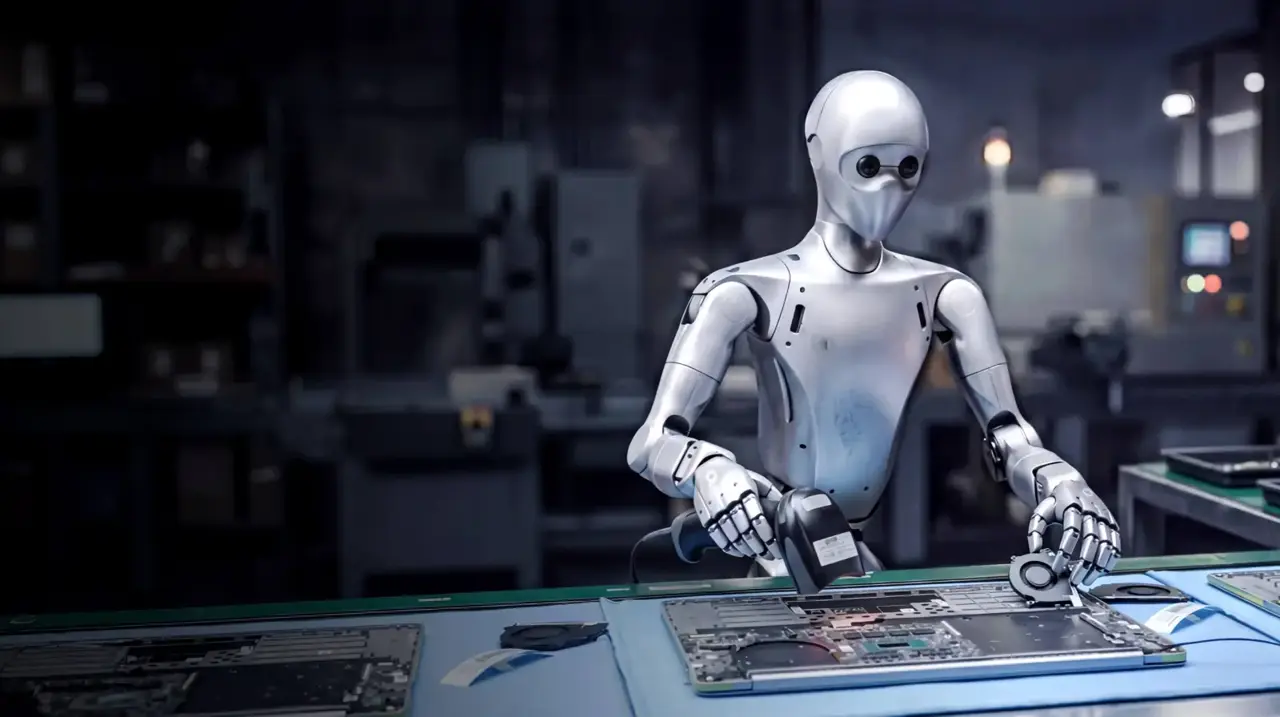
On June 1, 2026, Unitree Robotics and NVIDIA introduced H2 Plus for universities, laboratories and physical-AI developers.
The reference design brings together Unitree’s humanoid body, Sharpa articulated hands and NVIDIA Jetson Thor computing with the Isaac GR00T ecosystem. Its central promise is to reduce the amount of groundwork each research group must do before it can collect demonstrations, train a model and test it on a physical robot.
Unitree H2 Plus: key specifications
| Feature | Announced information |
|---|---|
| Manufacturer | Unitree Robotics |
| Collaborators | NVIDIA and Sharpa |
| Use | Physical-AI research and development |
| Height | 1.82 m |
| Published weight | About 70 kg |
| Body joints | 31 degrees of freedom |
| Sharpa Wave hands | 22 active degrees of freedom per hand |
| Reference total | 75 degrees of freedom |
| AI processor | NVIDIA Jetson AGX Thor T5000 |
| Announced performance | Up to 2,070 FP4 TFLOPS with sparsity |
| Module memory | 128 GB unified |
| Nominal arm payload | About 7 kg |
| Removable battery | 0.972 kWh |
| Announced runtime | About three hours |
| Published price | US$100,000 |
| Expected availability | Late 2026 |
Figures come from Unitree and NVIDIA. Features depend on configuration: Unitree’s specifications identify the Sharpa hands and wrist cameras as optional. Announced performance is not independent operational test evidence.
How is it different from Unitree H2?
The standard H2 already provides a human-scale body with legs, arms, waist and articulated head. Its 31 degrees of freedom support coordinated movement.
H2 Plus uses that body as a base and adds components intended for advanced manipulation and machine-learning research. It is not simply “a faster H2.” Its value is the reference combination of hardware and development tools.
| Feature | Unitree H2 | Unitree H2 Plus |
|---|---|---|
| Body | 31 degrees of freedom | 31 degrees of freedom |
| Dexterous hands | Depends on configuration | Two Sharpa Wave hands in the reference design |
| AI compute | Base or expandable configuration | NVIDIA Jetson Thor T5000 |
| Development stack | Options by version | Isaac GR00T integration |
| Published price | US$29,900 | US$100,000 |
| Main audience | Development and specialized applications | Advanced physical-AI research |
Researchers should still compare the exact H2, H2 EDU and H2 Plus configurations. A reference design is not a guarantee that every component, camera or hand is included in every order.
Why 75 degrees of freedom?
Degrees of freedom are independently controllable movements. H2 Plus has 31 in its body—six per leg, seven per arm, three in the waist and two in the head. Two 22-degree-of-freedom Sharpa Wave hands bring the reference total to 75.
The hands matter because manipulation can demand more variation than a simple industrial gripper. Five fingers and tactile sensing may help a control system adjust its grip as an object slips or needs less force.
That does not make manipulation automatic. More joints create more possible motions and more control decisions. A robot still has to perceive an object, choose an approach, coordinate its body and recover when a grasp fails.
Jetson Thor and Isaac GR00T: how the platform learns
H2 Plus uses NVIDIA Jetson AGX Thor T5000, a Blackwell-based module with 128 GB of unified memory. NVIDIA quotes up to 2,070 FP4 TFLOPS with sparsity. That is a compute figure under specific conditions, not a direct measure of robotic intelligence.
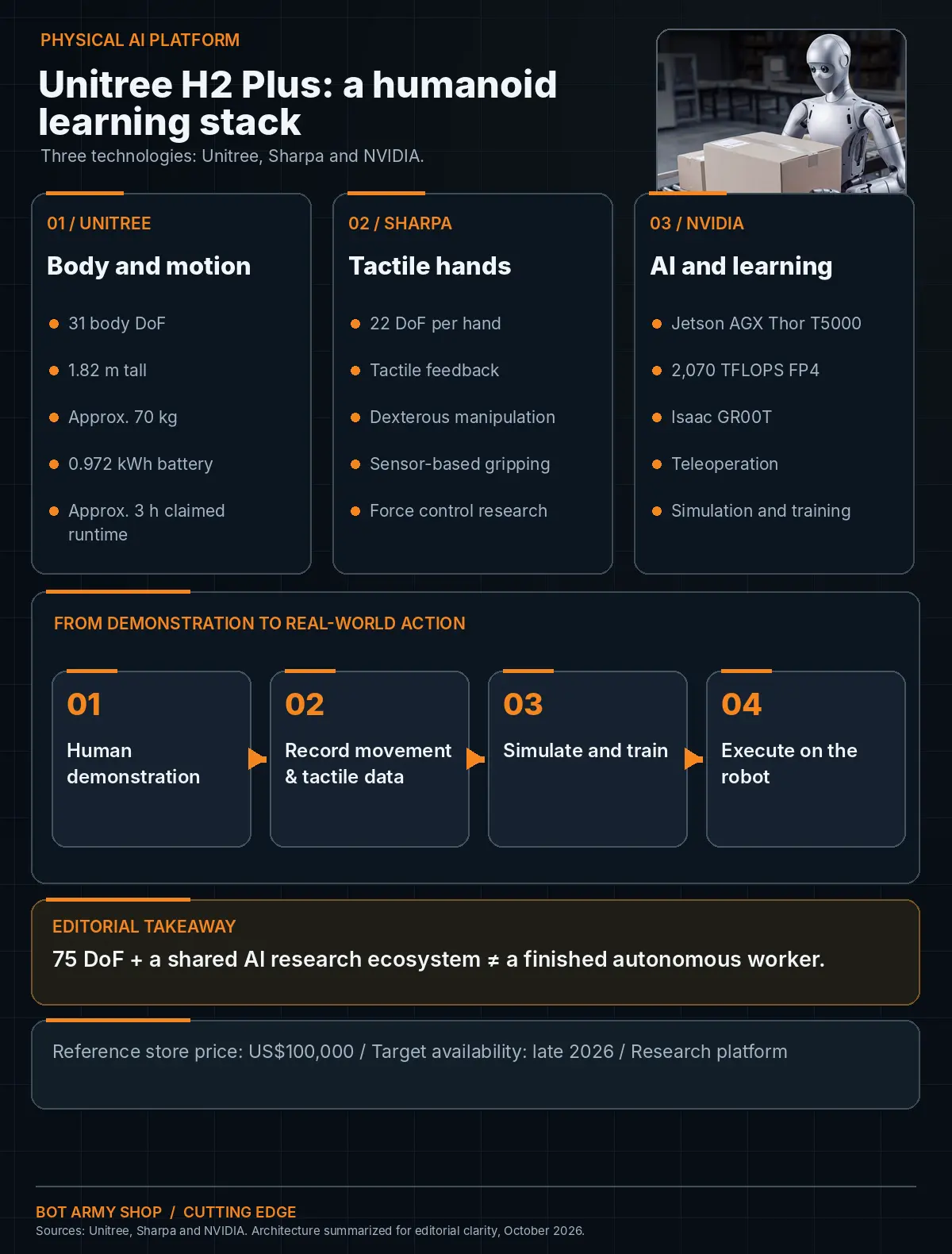
The larger idea is the development pipeline around it:
| Tool | Role |
|---|---|
| Isaac Teleop | Capture human-guided demonstrations |
| Isaac GR00T | Develop and adapt robot-action models |
| Isaac Sim and Isaac Lab | Simulate, train and evaluate behaviors |
| Isaac ROS | Connect models to robot systems |
| Jetson Thor | Run processing and inference onboard |
A laboratory might record demonstrations of placing tools in a box, train a model on images and actions, test parts of it in simulation and then evaluate it on the real robot. Simulation can accelerate experiments, but it does not perfectly reproduce friction, weight, lighting or unpredictable objects.
Can H2 Plus already work autonomously?
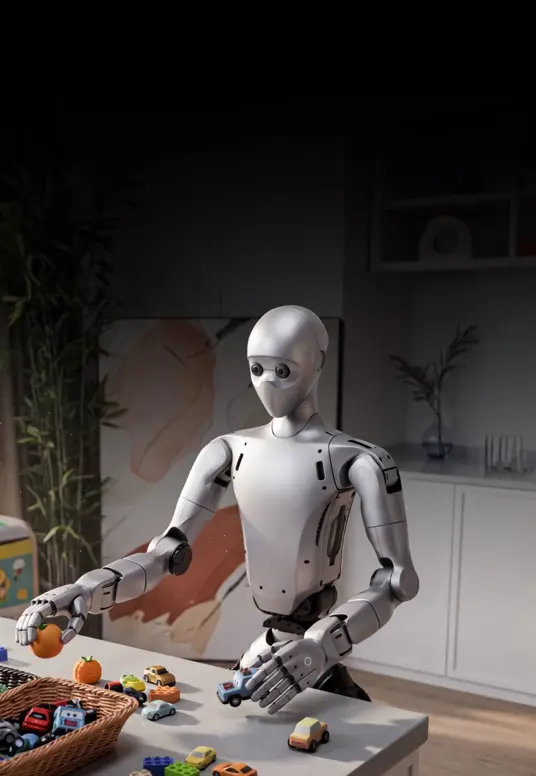
It is built to develop autonomy, not to arrive with a complete set of job skills. The published material describes hardware, sensors and software tooling, but does not provide enough independent evidence about long tasks performed without human help.
A seemingly simple task—picking up a tool and putting it on a shelf—requires recognizing it, selecting a grip, maintaining balance and correcting mistakes. Researchers will need task-success rates, execution times, error rates and intervention data to evaluate progress.
Price, availability and who it is for
Unitree lists H2 Plus at US$100,000 and asks buyers to contact its commercial team. The figure is a reference price, not a complete quote for every country or configuration. Customs, support, accessories, maintenance and trained staff can substantially change the real cost.
The platform makes the most sense for institutions studying physical AI, learning from demonstration and advanced manipulation. A business that only needs to move identical boxes between fixed locations may be better served by a specialized industrial system.
Galileo-9’s reading
The important wager is not just a powerful humanoid. It is a shared research reference: one body and one tool chain that may let different teams compare methods and reproduce results.
That will only matter if the platform produces published, repeatable evidence. H2 Plus is best understood as supervised research infrastructure—not as a general robot ready to join daily work.
Sources and methodology
This analysis uses Unitree, NVIDIA and Sharpa documentation together with independent reporting. It is not a physical H2 Plus test or an experimental evaluation.
Bot Army Shop Editorial Team · AI-assisted research and human editorial supervision.
- Unitree Robotics. H2 Plus specifications.
- Unitree Robotics. H2 specifications.
- Unitree. H2 Plus commercial information.
- NVIDIA. Isaac GR00T reference humanoid announcement.
- Reuters. NVIDIA and humanoid-robotics collaboration.
Editorial review: October 11, 2026.