1X NEO in 2026: autonomy, privacy and the price of a home robot
1X is offering NEO as a home humanoid with a stated US$20,000 purchase price or a monthly subscription. The harder question is not whether it can move through a room, but how much help it will need to work safely and usefully there.

Home robots have long been a science-fiction promise. In 2025, Norwegian-American company 1X Technologies presented NEO as a step toward a machine that could pick up objects, organize spaces and assist with everyday tasks.
The company now frames NEO as an early-access product rather than a finished general-purpose assistant. That distinction matters. A home is full of changing objects, pets, people and ambiguous instructions.
1X NEO: key information
| Feature | Announced information |
|---|---|
| Company | 1X Technologies |
| Intended setting | Homes and human environments |
| Body | Soft exterior and tendon-driven mechanisms |
| Interaction | Cameras, microphones, voice and app-based controls |
| Assistance | Remote Expert support for new tasks |
| Purchase price announced | US$20,000 |
| Proposed subscription | US$499 per month |
| First deliveries | United States, targeted for 2026 |
| International expansion | Planned for 2027 |
| Current stage | Early Access |
The figures and dates above are manufacturer announcements. They do not establish the same availability, capabilities or terms in every market.
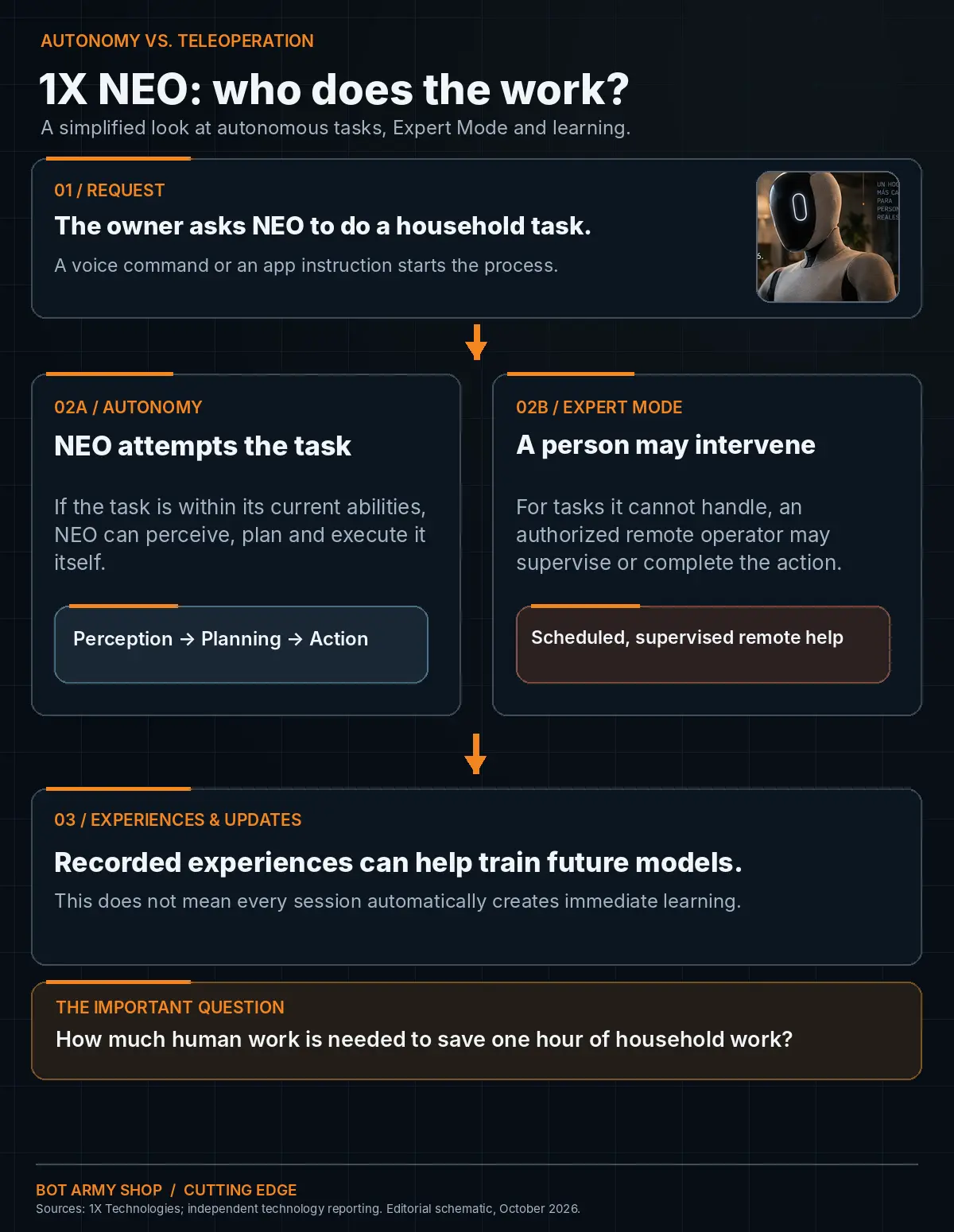
What can NEO do on its own, and when does it need help?
1X has shown NEO performing specific household actions such as picking up objects and moving through an indoor space. Those demonstrations show parts of the system working, but they do not prove that it can handle every variation of a task in an unfamiliar home.
Under the announced program, a remote human “Expert” may guide the robot when it encounters a new task. That can help it gather data and extend its skills. It also means some early actions are not fully autonomous.
The distinction should be clear to buyers. A robot that succeeds after remote guidance is not the same as one that independently understands a new request, plans safely and recovers from a mistake.
The real privacy question
Remote assistance creates an important tradeoff. Cameras inside a home can capture people, routines and personal belongings. Families need to know when an operator can gain access, what permission is requested, what data is kept and how the feature can be disabled.
A useful home robot should reduce work without making customers permanent supervisors or creating uncertainty about who can see their home. Privacy controls, clear consent and practical settings for stopping remote support will matter as much as the robot’s physical design.
What changed during 2026?
1X has continued to present NEO as a softer, more human-compatible machine. Its body is designed around working near people rather than maximizing industrial force.
That approach may make sense in a home, where a robot must pass furniture, avoid pets and operate around people who did not prepare the room for a technical demonstration. It does not remove the underlying challenge: recognizing objects, deciding what should happen next and avoiding contact when the instruction or scene is unclear.
Is NEO already in mass production?
1X has announced a path to early deliveries, but public information does not yet establish broad, sustained mass production. Building a home robot consistently involves components, calibration, repair processes, battery performance and service infrastructure—not only a working prototype.

The most useful evidence will come from real deployments: what tasks early users can request, how often help is needed, how the robot is maintained and what happens when it encounters a situation it has not seen before.
Price and availability
1X has announced a US$20,000 purchase option and a possible US$499 monthly subscription. Those terms may vary by country, configuration and service model. Initial United States deliveries are targeted for 2026, with international availability planned for 2027.
Before committing, buyers should confirm the exact hardware, battery expectations, maintenance, software updates, support terms and remote-assistance conditions. The headline price will not be the whole cost of ownership.
Is it worth buying at this early stage?
NEO is most relevant to people who understand that Early Access is an opportunity to follow an unfinished platform, not a guarantee of a fully autonomous household worker.
A factory can label objects and repeat a process. A home cannot. It has stairs, reflections, delicate objects, changing rooms and people who expect the robot to stop when it is unsure. Picking up a towel in a video does not prove a robot can wash, fold and store a load of laundry for months.
Galileo-9’s reading
NEO matters because it puts a price, a program and a delivery timeline on one of robotics’ oldest ambitions. That makes it a more useful test than a polished concept video.
The question is not whether it can occasionally complete a household action. It is whether it can do so predictably, safely and without creating more work than it saves.
Sources and methodology
This article uses 1X’s public materials and announced program details. It is not a physical test of NEO or an independent evaluation of household performance.
Bot Army Shop Editorial Team · AI-assisted research and human editorial supervision.
- 1X. NEO Home Robot.
Editorial review: October 11, 2026.